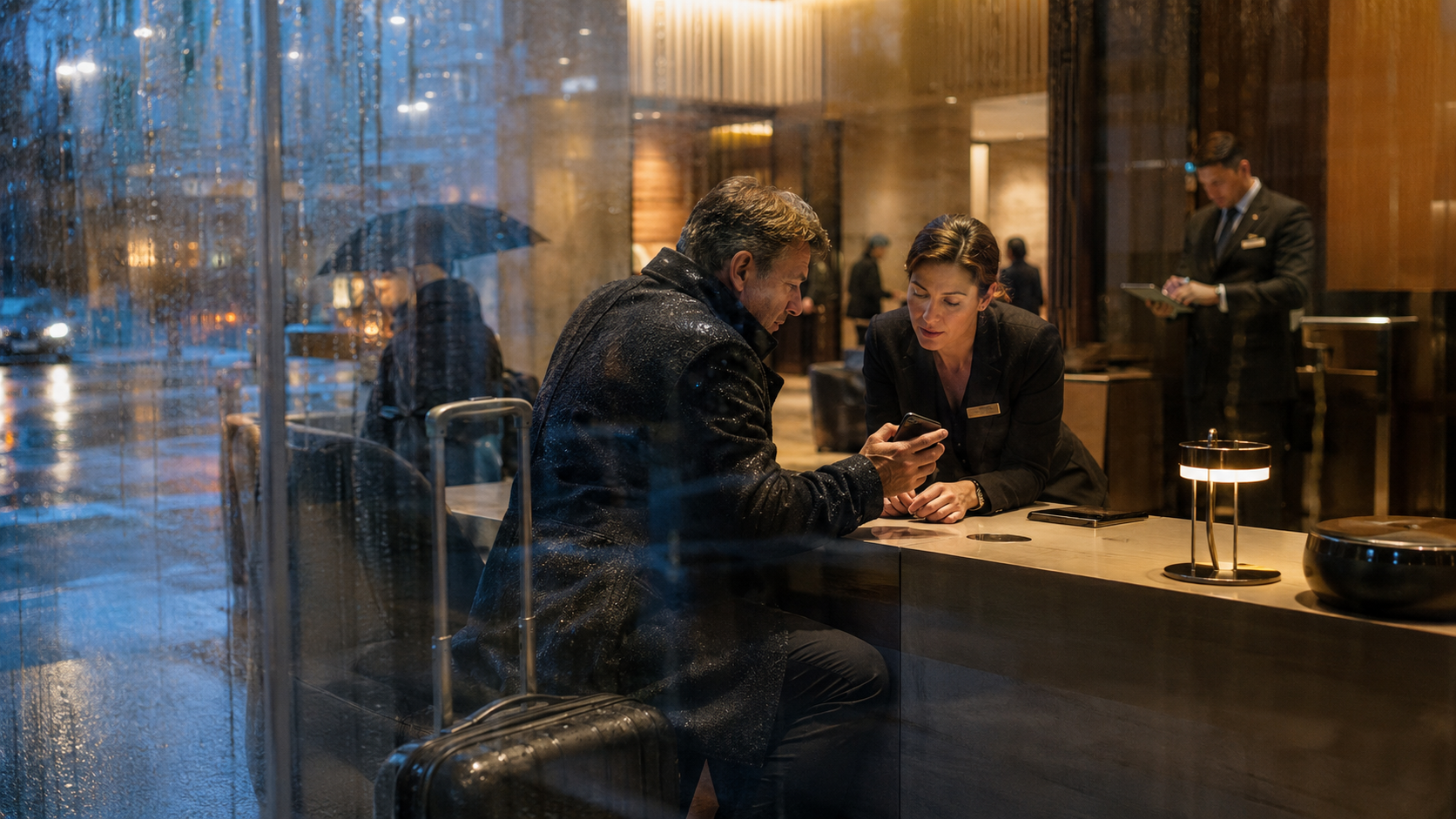

At 22:14, a message enters the hotel inbox:
“Good evening. I was about to book direct, but the same room is 28 euros cheaper on Booking.com. Screenshot attached. Why is your website more expensive?”
The screenshot shows the familiar room photographs, the dates, and a crossed-out price. The battery icon in the corner is almost empty. The guest has probably opened five tabs and wants to finish the search tonight. The hotel has a few minutes to demonstrate not its skill at “handling objections,” but the quality of its work.
The worst replies are born in that rush: “Our price is correct,” “Booking must have done something,” “Book there if it is cheaper,” or an unverified instant discount. They deny the evidence, pass blame, close the direct channel or conceal a system fault.
A sound response follows a different sequence: thank → rebuild the exact basket → classify the mismatch → explain or admit it honestly → offer a resolution → leave one next step.
This is not a script for defeating an OTA. It is a way to help a person compare genuinely equivalent offers and preserve trust, wherever the reservation is ultimately completed.
First, show the guest that you will not argue against the evidence
The first reply should not begin with a defence. Begin with thanks and a short commitment to investigate.
Baseline first reply
Thank you for sending the screenshot. You are right to compare the final cost before booking. I will now check the same dates, room, guests, cancellation terms, meal plan and total payable amount, then come back with a specific answer within ten minutes. Please send the offer link as well if it still opens for you. You can cover any personal or payment details in the screenshot.
This does not promise, “We will definitely go lower.” It gives the guest something more credible: you accept the observation as evidence, name the comparison criteria and set a response time.
If the team is not staffed overnight, give a realistic time: “We will verify it by 09:30 local time.” If the room may sell, say plainly that it is not yet on hold.
Compare the basket, not the headline number
“The same room” on two screens often turns out to be two different products. A rate is shaped by more than the category and dates. The hotel needs to reconstruct the offer as this guest saw it at 22:14:
exact property and room type;
dates, number of nights, adults and children, including children’s ages;
number of rooms;
meals and other inclusions;
cancellation deadline and charge;
prepayment, charging time and ability to modify;
every mandatory tax and fee;
display currency, charge currency and a possible card-issuer fee;
signed-in status and loyalty tier;
mobile, geographical, partner or otherwise closed rate;
promo code, reward, cashback or a discount funded by someone other than the hotel;
time of the check and whether the offer is still available.
This is not administrative theatre. Even the Booking.com price-match terms define “the same” through the property and accommodation type, dates, occupancy, meal plan, cancellation policy and other conditions. The same terms explain that some price reductions may be funded by the platform, while some offers depend on membership, signing in or another user action.
The Google Hotel Center Price Accuracy Policy applies a similar logic from another side: after a click, the rate should match the selected dates and occupancy, remain bookable, include mandatory charges and clearly disclose refundability. Google also supports conditional and private rates based on device, country, language, signed-in status or membership. Two people can therefore see different rates without either screen being fabricated.
Six different causes can produce the same complaint
Not every lower rate is an error, and not every difference is an unfair discount. Classify the case before the team chooses its tone or remedy.
Mismatch type | What to verify | Right response direction |
|---|---|---|
Different conditions | cancellation, payment, meals, occupancy | explain the difference without belittling the cheaper option |
Closed or subsidised rate | login, loyalty, mobile label, cashback | explain who can see the rate and under which condition |
Taxes, fees or currency | final screen, local charges, conversion, card fee | compare final totals in one currency |
Stale data | screenshot time, cache, PMS/channel-manager sync | recheck and repair the affected channel |
Direct-channel error | rate rule, code, occupancy, booking-engine page | admit it, correct it and offer a concrete remedy |
Genuine strategic difference | equivalent basket but another public rate | say honestly whether the hotel matches and what the direct offer contains |
Classification prevents the team from blaming an OTA for the hotel’s own rate-rule error — or discounting unnecessarily when the cheaper offer has materially different conditions.
The response has six moves but should sound like one human conversation
After checking, do not send the guest a two-page audit. Build a short arc.
Thank: “Thank you — you did find a lower total.”
Rebuilt basket: “We compared the room, dates, two guests and final payment.”
Mismatch type: “The lower price is a signed-in loyalty rate,” or, “This is our synchronisation error.”
Honest explanation: only what the evidence supports.
Resolution: match, correct, explain a measurable difference, or let the guest choose the OTA without friction.
One next step: one link, one confirmation or one accepted handoff — not a menu of five options.
Do not turn the explanation into a distribution lecture. The guest needs to know whether the conditions match, what they will pay and what to do now.
Copy-ready replies for six real cases
1. The offers have different conditions
Thank you — the lower amount in your screenshot is real. We compared the offers: the OTA rate is charged now and non-refundable, while our website rate can be cancelled free until 18:00 on 12 September and paid later. The room, dates and occupancy are the same; the difference is flexibility. If the non-refundable option suits you, here is our equivalent direct rate at [amount]. If flexibility matters, the cancellable rate is [amount]. Which one should I hold as the next step?
2. The OTA shows a signed-in, mobile or platform-funded discount
You are right: your OTA account shows [amount]. We checked the same dates and conditions. This is a closed/mobile platform offer available with your status; part of the reduction is not displayed as our public rate. We will not describe it as an error. Direct, we can offer [amount], including [only a real inclusion]. If the lowest final total is your priority, you can safely choose the OTA rate available to you.
3. The direct site is genuinely higher and the hotel matches
Thank you for helping us spot this. We rebuilt the same basket: [room], [dates], [number of guests], with equivalent cancellation terms. Our site was genuinely higher — that is our error, not yours. We are correcting the setup and can confirm a direct price of [amount]. Here is a secure link, valid until [time] local time while the room remains available. Would you like to continue to checkout?
4. The hotel does not match
Thank you for the screenshot. We have checked: the offers are equivalent and the OTA is currently [amount] lower. We cannot honestly promise the same direct total. Our direct rate is [amount] and includes [name only a measurable difference]. If you do not need that inclusion, we understand choosing the lower OTA rate. If you do, I can send one direct checkout link.
An honest “we cannot” is better than inventing “better treatment for direct guests.” Service should not silently depend on booking channel.
5. Taxes, fees or currency caused the gap
We checked the final step of both booking flows. The OTA first shows [amount], but after the mandatory [fee] the final amount is [amount]. Our website total of [amount] already includes [taxes/fees]. For a fair comparison, both offers are shown here in [currency] using the conversion or rule disclosed before payment. If your final screen is different, please send a cropped screenshot without your name, reservation number or payment details and we will check again.
6. The guest has already booked through the OTA
Thank you. Your OTA reservation is already confirmed, so we do not recommend cancelling it or creating a duplicate. We will preserve the current conditions and check whether the platform offers a price-match process for this booking. Booking.com, for example, applies its own eligibility rules and requires equivalent conditions. You can contact its support here: [link]. On the hotel side, we can confirm that reservation [number] is visible / has not yet reached our system — select the truthful line. I can check the status and send one update by [time].
Do not tell the guest to cancel an existing OTA reservation in order to rebook direct. Booking.com’s terms state that cancellation charges and refunds depend on the booked rate’s policy; cancellation can also invalidate its price-match process. A duplicate can leave the guest with two charges — or no room after inventory updates.
A screenshot is diagnostic evidence, not permission to collect everything on it
To investigate, the hotel needs the property, room type, dates, occupancy, inclusions, conditions, currency, final total, timestamp and any closed-rate label. It does not need the guest’s full name, email, phone number, reservation ID, QR code, card details, reward balance or other trips.
Ask the guest to crop or cover what is unnecessary. Do not forward the image into a general staff chat; restrict access and retention. Article 5 of the GDPR requires personal data to be adequate, relevant and limited to what is necessary.
An internal record can say: “14 Aug, 22:14; Deluxe King; 20–22 Sep; two adults; OTA lower by €28; mobile/member label; URL; verified 22:21.” That is enough for rate diagnosis. A passport image, full card screen or entire account view is not.
Do not blame the OTA — even when the mechanism sits on its side
“The platform is dumping our rate” may be false. An OTA can fund a discount, a price can be conditional, or display can be personalised. Booking.com explicitly says that some price incentives are funded by the platform. Google documents valid rate conditions based on device, country, language and sign-in status. Establish the mechanism before writing the conclusion.
Nor is direct “by definition always cheaper.” The European Commission’s explanation of the DMA obligations for Booking.com says EEA hotels may offer better prices and conditions on their own and other channels. That is an opportunity, not a requirement to have the lowest direct rate every second. Applicability depends on territory and contract; this is not legal advice.
The UK CMA’s accommodation-booking guidance likewise says discount comparisons should be like for like and totals should include unavoidable charges. A guest should not need to decode distribution architecture to understand a bill.
The future is not an automatic discount; it is automatic evidence
The next-generation hotel inbox should not argue with a screenshot or improvise a discount. It may extract offer parameters, mask unnecessary data, rebuild the direct basket, label each amount’s source and suggest the likely cause. Exceptions and compensation should remain within defined authority.
That workflow should preserve more than the final wording. It should preserve evidence:
exactly what was compared;
when and in which channel it was checked;
where the rate and conditions came from;
who approved an exception;
which resolution was offered;
whether the guest accepted the next step;
whether the root cause was fixed for future guests.
No AI inbox should be assumed to do this without integrations and rules. A model may parse the message and draft a reply, but rates need a current source, authority needs hotel policy and accountability needs an owner. See “Next-step logic: how a bot should move a guest toward booking”.
Turn each screenshot into a system correction
After replying, record the cause. If it is an error, assign the rate owner, test other dates and categories, then compare again after the fix. If it is legitimate, add the explanation and an approved script to the knowledge base.
That is how one message at 22:14 becomes more than a reason for a situational discount. It becomes a sensor for the quality of the direct channel.
The guest is not asking the hotel to defeat the internet. They are asking it to explain two numbers without making them regret their trust. Thank them. Rebuild the basket. Name the truth. Offer a fair resolution. Leave one step.
Start redesign with twenty real conversations. Check whether the team can see the rate, conditions, source and accountable person alongside the message. Greetio can support that process conversation; one technology alone cannot repair rate strategy.