Services, not just rooms
Spa and service booking built into the guest conversation
Service booking software for hotels that sell more than nights: sauna, spa, massage, activities, rentals. Greetio holds the catalogue with prices that change by duration, checks capacity and staying-guest rules, writes the session into a staff calendar, takes payment for a service booked on its own, and pushes the charge back to Servio where the property runs it. It is not a standalone spa system for a city salon — it is the service layer of a hotel inbox, so the same conversation that quotes a room can sell the sauna in it.
- Priced by duration
- Capacity and guest-status checks
- Payable on its own
Why hotel services under-sell
Not because guests do not want them. Because booking one is harder than asking about one.
The service desk keeps office hours; demand does not
Interest in a sauna peaks in the evening, which is exactly when the person who can book it has gone home. The enquiry dies as an enquiry.
One price for a service that is not one length
A sauna for one hour and for three hours are different products with different prices. Systems that hold a single number per service either undercharge or force a human into every booking.
Double-booked sessions and unclear capacity
Two guests promised the same 20:00 slot by two different people, or a session sold to six when the room holds four. Both end at reception, as a complaint.
The service is booked but never billed
Sessions written on paper or in a chat do not reach the folio. What is not charged is not revenue, and nobody can tell how much of it was lost.
How service booking works
Catalogue, calendar, rules, money — in that order.
- 1
Build the catalogue with real prices
Each service gets durations and a price ladder: an hour, two hours, an evening. Resource-level pricing means the same service can cost differently in different rooms or with different equipment.
- 2
Say where the sessions live
The property states which calendar its services belong to rather than having it inferred from where its rooms are. Sessions land in a staff-facing service calendar with drag-and-drop.
- 3
Set the rules the AI must respect
Capacity per session, staying-guests-only where it applies, the booking payment window, and whether the AI is allowed to offer this service as an add-on at all.
- 4
Take the money and post the charge
A guest booking only a sauna can pay for it through a link in the chat. Where the property runs Servio, the service charge is pushed back to the PMS instead of living in a chat log.
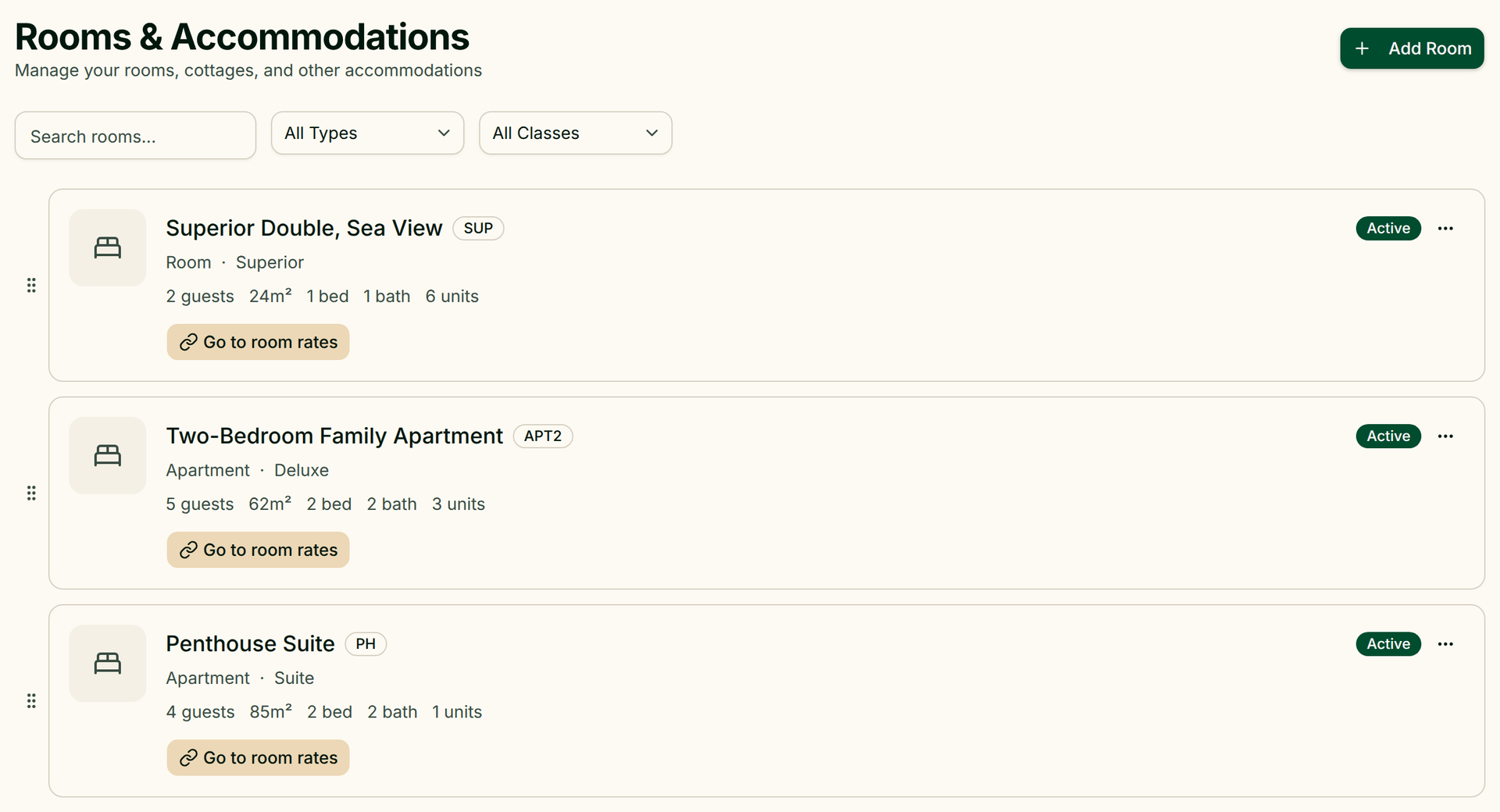
What the service layer holds
Built for hotel services, with the boundaries stated.
Price ladders by duration
One resolver decides a service's price and multiplies by the hours actually asked for, so a two-hour request is quoted as two hours and not as one.
Capacity and eligibility checks
A session is offered only if the slot exists, capacity allows and the guest qualifies where a service is limited to people staying at the property.
Real free hours for vague times
"Tonight" or "this evening" is answered with the hours actually left today, not with the opening times.
A staff service calendar
Sessions are visible and movable by the team, with unavailable rows disabled so nobody books into a slot that does not exist.
Held until paid, confirmed on the webhook
A session can be held until payment clears and is confirmed automatically when the provider's webhook arrives, so a slot is neither given away nor blocked by an abandoned checkout.
Charges synced to Servio
Where the property runs Servio, service bookings and their charges are synced into the PMS, so what was sold is what gets billed.
A paper book and a phone versus service booking in the inbox
Compared with how most hotel spas and saunas are actually scheduled.
| Today: notebook, phone, whoever is on shift | With Greetio | |
|---|---|---|
| Evening enquiry | Answered tomorrow, if remembered | Answered and booked, with the real free hours |
| Two-hour session | Priced by hand, sometimes wrongly | Priced by the ladder, multiplied by the hours asked for |
| Capacity | Known by one person | Checked before the session is offered |
| Payment | Cash at the desk, or forgotten | Pay link in the chat, before the session |
| Billing | Written down and sometimes lost | Charge synced to Servio where the property runs it |
Scenario: selling a two-hour sauna at 18:45
The spa desk is closed. The guest has not booked a room — they live in town.
- Two hours were priced from the ladder, not by doubling the one-hour rate
- Capacity for four was checked before the slot was offered
- The session was paid for on its own, with no room booking involved
Illustrative conversation. The AI offers only sessions that exist, fit capacity and match your rules; a service limited to staying guests is not offered to anyone else.
Want to see Greetio on your property?
Three fields, and we'll show how it works at your hotel.
The unglamorous reason this matters
Hotel services are usually sold badly not because nobody wants them but because the sale requires a person to be available at the moment of interest — and the moment of interest is the evening. Moving the catalogue, the capacity rules and the payment into the conversation removes the person from the critical path and leaves them the part that needs judgement.
- Prices follow duration, so a two-hour session is quoted as a two-hour session
- Capacity and staying-guest rules are checked before the offer, not after
- The charge reaches Servio instead of a chat log
The sauna used to sell when someone happened to be at the desk. Now it sells at nine in the evening and it's paid for before anyone unlocks the door.
Hotel service booking: common questions
No, and it is not aimed at standalone salons. It is the service layer inside a hotel inbox: a catalogue, capacity rules, a staff calendar and payment, so the conversation that already answers about rooms can also sell and book a session.
Yes. Each service holds a price ladder by duration, and one resolver applies it against the hours actually requested. Resource-level pricing lets the same service cost differently depending on the room or equipment used.
That is your choice per service. Where you mark a service as staying-guests-only, the AI checks that before offering it; otherwise outside guests can book and pay for a session on its own.
In a staff-facing service calendar, with unavailable rows disabled and drag-and-drop for moving a session. The hotel says which calendar its services belong to rather than having it guessed from where its rooms sit.
For properties running Servio, service bookings and their charges are synced into the PMS. For other systems and for properties without a PMS, the booking and payment live in Greetio.
Yes, but only what you allow: which add-ons are offered is a hotel-side setting rather than an internal ranking, so you decide what gets promoted and when.
The AI answers with the hours that actually are free today for that service rather than repeating opening times — and if it cannot verify availability at all, the conversation goes to a person.

Want to see Greetio on your property?
We'll show how AI replies from your data, which channels to connect first and how to launch onboarding.
Explore Greetio by use case
Let the sauna sell itself at nine in the evening
Start onboarding yourself, or leave a request and we'll set it up on your own service catalogue.
Start onboarding