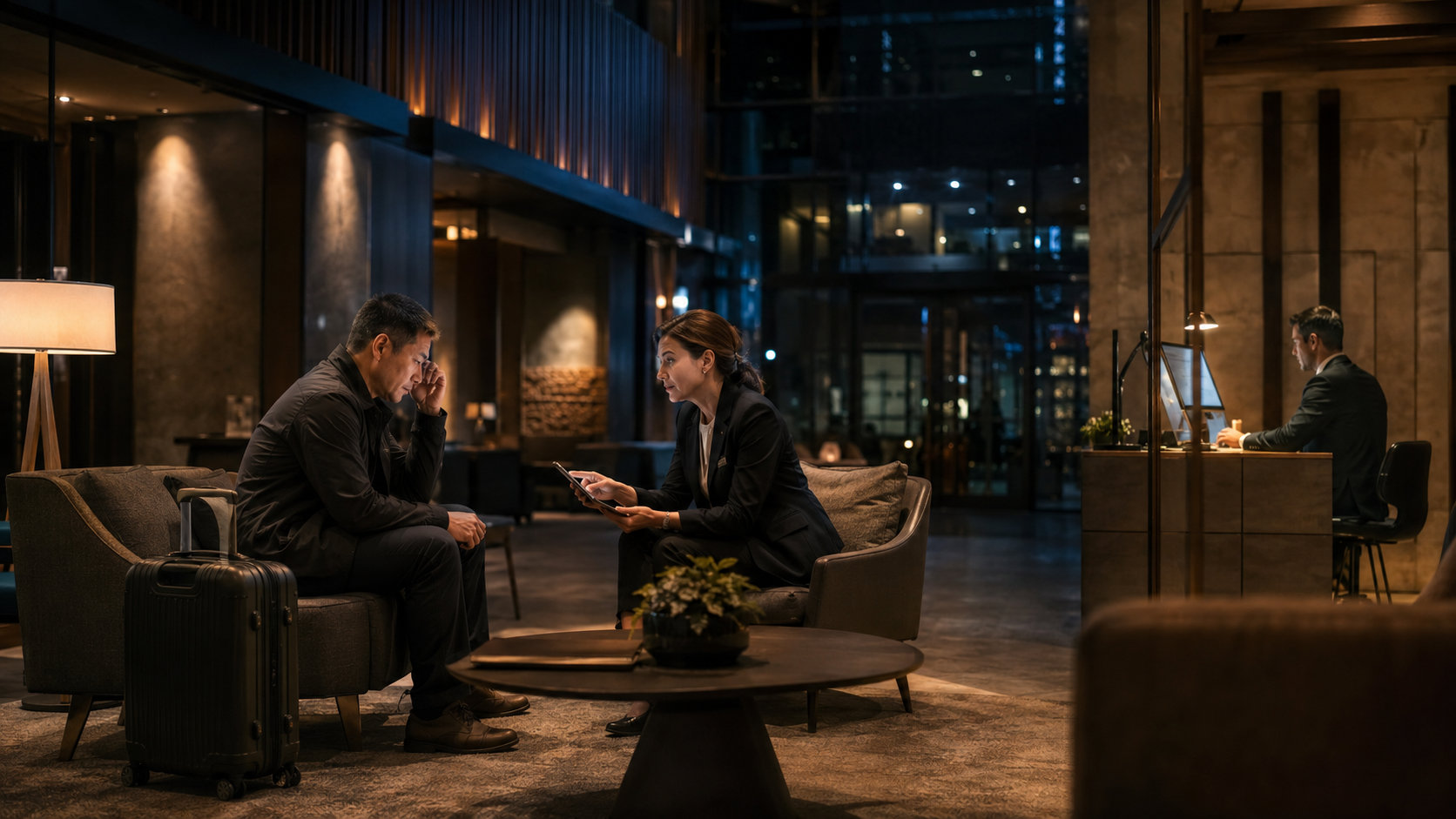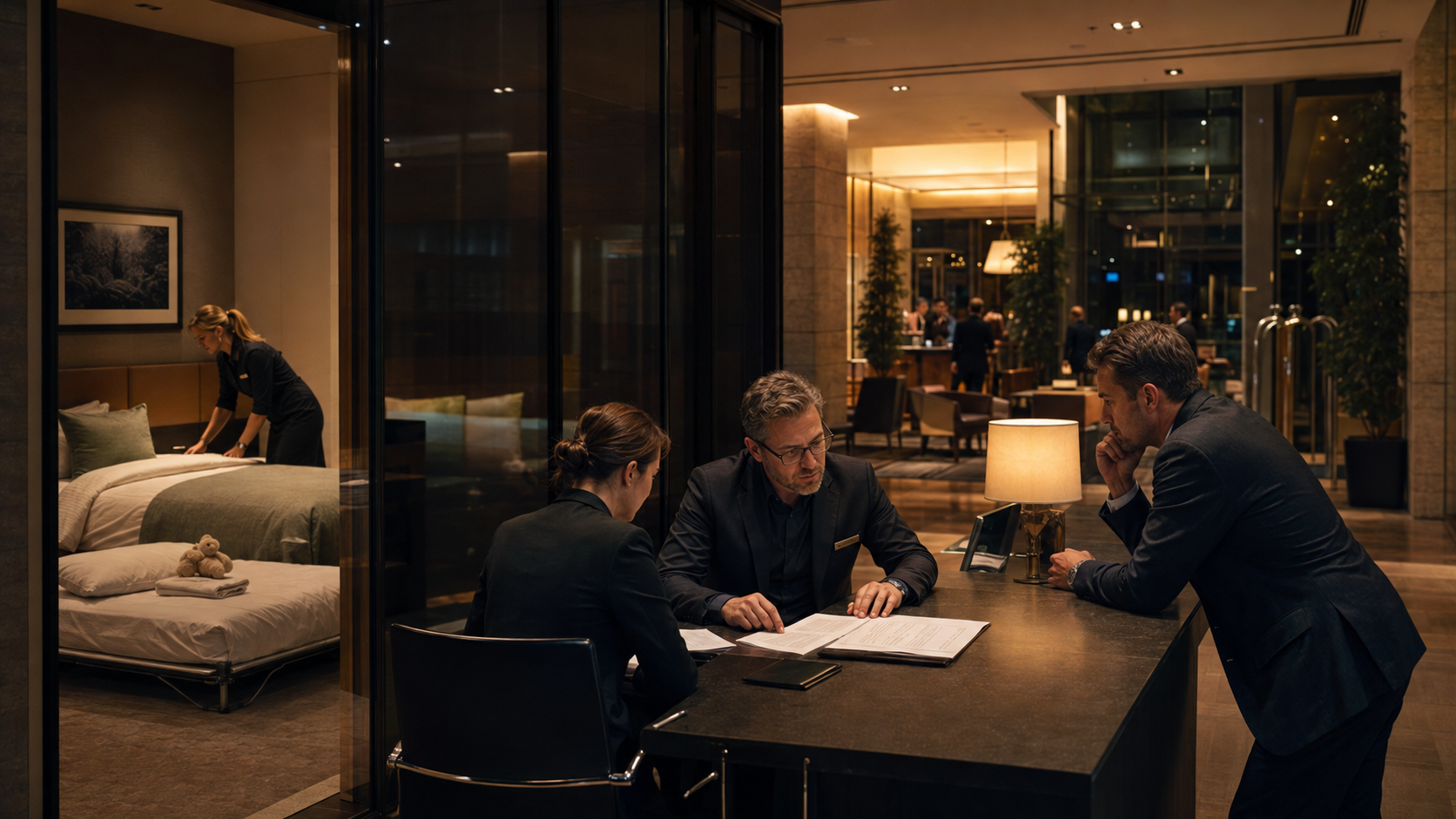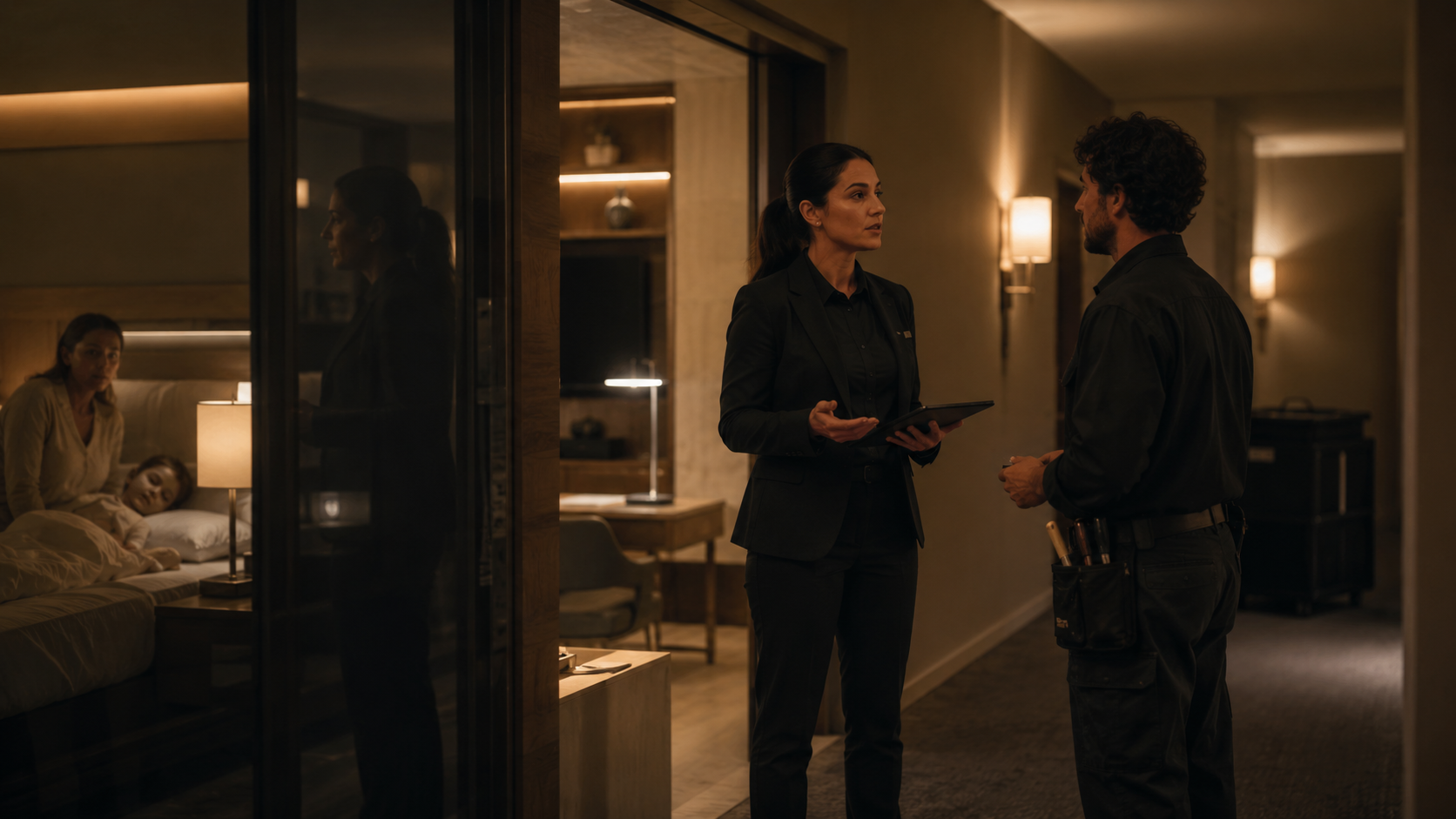

At 10:47 p.m., a guest writes: “I can hear water inside the wall, but my child is already asleep. Is there anything you can do without moving us?” The AI recognizes that this is no longer a question for the hotel FAQ. It requires judgment from the night manager and a technician, and perhaps a careful discussion about another room. The conversation is handed to a person. But what happens to the AI next?
In a poorly designed system, the answer is unclear. One automated sequence still sends a reminder, another asks for the room number again, and the manager is simultaneously arranging for a technician. The guest hears two voices and cannot tell who actually owns the problem. In a mature system, the handoff changes more than the speaker. It changes the right to act. The employee takes control of the guest-facing channel. The AI becomes silent to the guest and enters shadow mode: it processes only permitted context, helps the employee understand the case, and neither sends nor acts on the hotel’s behalf by itself.
A note on terminology. In this article, “shadow mode” is a working name for an operating model between AI and hotel staff. It is not a claim that Greetio currently offers a separate feature with this name. Actual capabilities depend on the product version, connected systems, and configuration.
The future of hotel AI will not be defined by how long it can keep talking without a person. A more important test is whether it recognizes the moment when it should stop, transfer responsibility, and remain useful behind the scenes.
Shadow mode does not mean turning AI off
Once an employee accepts the conversation, the AI stops being the guest’s interlocutor and becomes an internal assistant. It might identify the topic and urgency, summarize facts already established, retrieve the relevant hotel policy, flag a contradiction, or prepare a draft response. The result stays inside the staff workspace. The guest does not see it unless a person deliberately reviews, edits, and sends it.
There are practical precedents for this model in contact-center assistance. For example, Google Cloud describes Smart Reply as following a conversation between a human agent and an end user and surfacing suggested responses to the human. That distinction matters: a suggestion may be generated automatically, but control of the customer conversation does not silently move back to the system.
One guest channel, one accountable writer
The central rule of shadow mode is simple: at any moment, only one party has permission to send messages to the guest. While AI is active, an employee may observe or step in. As soon as the employee accepts the handoff, the AI’s permission to send must be revoked. That transition should be atomic, not a loose collection of flags held by different services.
Why is such strictness necessary in an ordinary hotel conversation? Because automated messages often have independent lifecycles. A system can contain inactivity reminders, retries, scheduled follow-ups, message queues, and integrations with several channels. Microsoft’s guidance on inactivity triggers explicitly warns that a trigger may remain active after escalation and unexpectedly send automated messages during a human-agent conversation. Its recommended defenses include ending the automated conversation or using a guard variable.
The technical cause does not matter to the guest. They see the manager write, “I have contacted our technician,” and ten seconds later receive, “Is there anything else I can help you with?” Trust is not lost because of a grammatical error. It is lost because no single participant appears responsible. A handoff is not an entry in a log. It is a transfer of control over the guest-facing channel.
A handoff needs a sequence of states
One “transfer to human” button hides several different moments. The guest requests a person; the system detects that request; the conversation joins a queue; an employee is notified, reads the context, accepts the case, resolves it, and may eventually return simple follow-up questions to AI. If all these events are labeled “handed off,” no one can reliably tell who owns the conversation now.
A useful sequence begins with AI active within an approved scope. When human help is needed, the system immediately blocks new free-form AI responses and prepares concise context. While the guest is waiting, it may display one preapproved status message, but it should not start a fresh automated exchange. Once an employee accepts the case, that person becomes the only guest-facing writer and the AI enters shadow mode.
There are two valid endings. The employee closes the conversation and invalidates earlier timers, or prepares AI re-entry by checking unresolved promises, defining the permitted topic, and explicitly returning control. The audit trail should show each transition and the source of every outgoing message.
The official Dialogflow LiveAgentHandoff documentation illustrates the difference between a signal and an operating procedure. The handoff signal indicates that a conversation should go to a live agent, but what happens next is left to the implementer’s handoff process. A product’s ability to emit a handoff event does not, by itself, prove that it safely manages queues, channel ownership, and re-entry.
What AI may do after the handoff
Shadow mode is useful only when its boundaries are written before the first difficult case. “Do not send a message” is necessary but incomplete. An AI could remain silent to the guest while changing a booking, creating the wrong task, or adding the conversation to a training dataset. Hotels therefore need separate policies for permitted internal assistance and actions that require human authorization.
Assistance that may be allowed | Safety condition | What must not happen silently |
|---|---|---|
Summary, intent, urgency, policy retrieval, or a draft response | Evidence is visible and the employee can correct or reject it | Sending to the guest, making a promise, or hiding uncertainty |
A proposed internal task or next step | A person confirms the owner, deadline, and details | Changing a booking, price, inventory, payment, or refund |
Recording whether a suggestion was accepted, edited, or rejected for evaluation | Purpose, access, and retention are defined in advance | Turning every conversation and edit into training data automatically |
“Internal” actions still affect guests. If AI creates an engineering task for the wrong room, silence offers no protection. A safer first stage is to propose the task while an employee confirms the room, assignee, and deadline.
Learning signals need boundaries too. When a manager edits a draft, the final wording does not automatically become a new hotel policy. It may be a one-time exception, a personal concession, or a human mistake. Accepted, edited, and rejected suggestions are valuable evaluation signals, but they should not rewrite the knowledge base without a separate review process.
AI re-entry cannot be triggered by silence
The most dangerous re-entry rule is to assume that employee silence returns the channel to AI. A manager may be calling the technician, inspecting another room, or speaking with the guest in person. To a software timer, that looks like inactivity. To the hotel, it is active work. If the AI resumes five minutes later, it has not helped; it has taken responsibility away from the person handling the case.
Re-entry should require an explicit action by an authorized employee. Before that action, the system should verify that promises and deadlines are recorded, no important task remains unowned, the AI has confirmed facts rather than inferences, and the scope of the next automated exchange is defined. If the change could confuse the guest, the interface should plainly indicate that the automated assistant is responding again.
Some conversations should remain human-owned until closure. These include disputes about charges or refunds, physical safety, health, discrimination or accessibility, matters involving children, legal demands, complaints, and situations where an employee has made a special promise. The cost of losing context in these cases is higher than the value of saving a few minutes.
Invisible to the guest does not mean harmless to their data
If AI reads the conversation after handoff, classifies the request, or prepares a draft, personal data is still being processed. A hotel needs to understand the purpose, lawful basis, recipients, retention period, access controls, and how data-subject rights can be exercised. Purpose limitation, data minimization, accuracy, storage limitation, security, and accountability are among the principles in Article 5 of the EU General Data Protection Regulation.
Consent is not a universal permission for any future use of a conversation. Depending on the jurisdiction and the specific purpose, another lawful basis may apply. Reusing guest conversations to train a model should not automatically be treated as the same purpose as processing data to answer the current request. The European Data Protection Board’s Opinion 28/2024 emphasizes that lawful-basis, necessity, and balancing assessments for AI models are context-specific.
Practical minimization begins with uncomfortable questions. Does the model need the entire conversation or only recent messages and a verified summary? Can card numbers, documents, passwords, and unnecessary identifiers be redacted first? Who can access drafts, and how long are intermediate summaries retained? Google’s Smart Reply documentation advises users to sanitize personally identifying information before sending data and remove children’s data rather than relying only on automatic redaction.
Transparency about who is speaking also matters for hotels serving the EU market. The European Commission’s guidelines on Article 50 of the AI Act explain transparency requirements that apply from August 2, 2026, including informing people when they are interacting with an AI system unless that is obvious. The exact application depends on the hotel’s role, market, and implementation. This article is an operating framework, not legal advice.
The staff workspace should reduce noise, not create a second boss
An employee needs one concise card, not another machine conversation. It should show “Human-owned conversation. AI cannot send,” followed by the handoff reason, a few sourced facts, the unresolved request, promises, urgency, unknowns, one draft, and one proposed next action.
The employee needs simple controls: use, edit, or reject with a reason. Rejection should not be hidden in a secondary menu because the ability to disagree is part of meaningful human oversight. At the same time, the system should not encourage rubber-stamping through a large green button or an unexplained confidence percentage. “Policy updated August 12,” “inventory not checked,” and “amount stated by guest” are more useful than a bare score.
In the Govern section of its AI Risk Management Framework Playbook, NIST recommends clear distinctions among human roles, authority, and responsibility in human–AI configurations, as well as documentation of the appropriate level of human involvement. For a small hotel, that does not require a new committee. It means giving the night manager clear boundaries, training, enough time, and genuine authority to say no to the system.
How to measure whether shadow mode works
The first metrics should concern control, not speed. The number of automated messages sent after a human accepts the conversation should be zero. Unauthorized changes to bookings, payments, or tasks should also be zero, as should AI re-entry without an approved transition. Each such event is more than an inaccurate response; it is a breach of the responsibility boundary.
Next, evaluate summary quality. Did the system preserve the booking number, amount, deadline, special need, and promise already made? Separately measure missed urgent cases, unnecessary copying of sensitive information, time to first human response, time to actual resolution, and repeat contacts about the same problem. Draft acceptance rate is useful but does not prove quality: staff may accept suggestions because they are hurried or overly trusting.
Averages can hide important failures, so separate results by language, channel, shift, property, and request type. NIST’s Measure guidance recommends tracking human overrides, complaints, response times, and exceptions. Its Manage guidance emphasizes ongoing monitoring for degradation, unusual behavior, and near misses.
How shadow mode fails
The most visible failure is the double voice: an old timer asks, “Can I help with anything else?” while the manager is arranging a repair. A quieter but equally serious failure is a stale fact in a draft: the system offers late checkout even though the policy changed yesterday. Another common pattern is handoff without ownership: the case is marked as transferred, but no person has confirmed responsibility.
Internal failures include a private note leaking into a reply, a summary dropping a promise, a one-time exception becoming training data, or a transcript retaining sensitive information that was not needed.
There is also the risk of a human who is present only in name. If the employee sees one prominent “send” button, has no time to inspect the source, and cannot easily reject a suggestion, the system effectively controls the decision. The person becomes the final mechanical click rather than an accountable participant. Shadow mode should strengthen staff judgment, not disguise automation under a human name.
A practical rollout plan
Start with the conversation states, not the model. For each state, write down who may send, who can see internal suggestions, which events move the conversation forward, and how the system can be stopped immediately. Then define the allowed and prohibited actions. Inspect every timer, queue, retry, and channel integration that could send after handoff.
Next, map what reaches the AI, why it is needed, where it is stored, who can access it, what is redacted, and whether it is used for evaluation or training. Design the staff card with night managers, reservations, housekeeping, and engineering; their real pauses matter more than an idealized process.
Evaluate in stages: minimized historical or synthetic cases; a silent comparison that cannot affect operations; staff-visible drafts without automatic sending; and only then, after stable multilingual results and a working emergency stop, limited AI re-entry for simple topics.
After deployment, review errors, near misses, rejected suggestions, and missing context regularly. Policies, staff behavior, and integrations change. If a capability moves outside the hotel’s risk tolerance, narrow or disable it rather than waiting for a complaint.
Honest limits: shadow mode cannot replace the hotel
Shadow mode cannot create a night manager where none exists. It cannot repair the air conditioner, turn an outdated rule into a correct one, or resolve unclear responsibility between departments. It does not supply a lawful basis for data processing, and it cannot guarantee that a rushed employee will meaningfully review every suggestion.
Its value is more modest and more fundamental: it establishes a disciplined boundary between automated assistance and human accountability. With that boundary in place, the guest does not have to repeat the story, the manager receives the right context, and the technology does not compete with the person for the final word.
The most advanced near-future hotel may not look technological. The guest notices that the night manager understands a child is asleep and returns with a real solution. The best AI in that scene is almost invisible; its quality appears in a calmer, more precise human conversation.
Three questions to ask before choosing a system
The best question for any vendor is not, “Can your system hand a conversation to a human?” It is, “What exactly can the system still do after the handoff?” Ask to see three things: the state sequence, the list of permitted actions, and the audit trail of a real transition from AI to employee and back. If one of these is unclear, the handoff is not complete; it has merely been announced.
When assessing Greetio or another system for a hotel, begin with your own difficult conversations. Mark the exact point where AI should become silent, what the employee needs to see, and who authorizes re-entry. That scenario will reveal more about system maturity than a flawless demonstration of ten simple FAQ answers.
Frequently asked questions
Is shadow mode the same as switching AI off completely?
No. AI stops sending guest-facing responses but may still assist an employee within explicit limits by organizing facts, retrieving a policy, flagging a risk, or preparing a draft.
Must the employee approve every draft?
In the safety-first model described here, yes, before the guest sees it. The employee should verify the facts, consider the circumstances, edit or reject the text, and send the final response themselves.
Can AI create an engineering task by itself?
It can propose one. Automatic creation or assignment requires a separately authorized rule, verified data, logging, and risk evaluation. A sensible first stage is recommendation rather than execution.
Does the guest need to consent to shadow mode?
That depends on jurisdiction, processing purpose, and lawful basis. Transparency still matters, but consent is not the only possible basis. Training on conversations should be assessed separately from using data to deliver the requested service.
When may AI return to the conversation?
After an explicit decision by the responsible employee, a check of outstanding commitments, transfer of verified context, and definition of a simple permitted topic. A pause or shift change is not permission by itself.