In build — coming soon
Reputation
Hotel reputation management that starts before the review is written
Most reputation tools begin their work after the damage is public. Greetio starts earlier: every conversation is scored 1 to 100 for satisfaction while the guest is still on the property, so a stay going wrong becomes a task for a manager rather than a one-star surprise a week later. Post-stay feedback mailings run today too — triggered after checkout or sent as a one-off campaign, on the messenger the guest already uses. Reply workflows for published reviews, drafted in your voice from what actually happened during the stay, are the part still in build.
- Scoring and feedback live
- Review replies in build
- Early access open
Why reputation work is usually too late to matter
By the time a review exists, the only move left is damage control.
The problem was visible and nobody saw it
The complaint about the noise was in a WhatsApp message at 23:00 on the second night. It was answered politely and never escalated — and it became the review.
Replies are written from nothing
Whoever answers the review usually has no idea what actually happened. The result is the generic apology every traveller has learned to discount.
Two shifts, two versions of the stay
Reception remembers one thing, housekeeping another, and the conversation that would settle it is in a personal phone.
Nobody knows which stays are at risk
Without a signal during the stay, every guest looks identical until the rating arrives. There is no list of the five people worth talking to today.
How it works — and what already works
Two halves: the early-warning half is running; the reply half is in build.
- 1
Every conversation gets a score — live today
A nightly job scores each conversation from 1 to 100 against a rubric and tracks guest sentiment as a recurring measure, not a one-off report.
- 2
A falling score becomes work — live today
A conversation trending badly is visible in the inbox with a satisfaction indicator in the chat header, and the underlying request can be assigned as a task with a status.
- 3
Published reviews are drafted for you — in build
The plan: a reply drafted from the real record of that stay — what was asked, what was promised, what was fixed — in your property's voice, for a manager to approve.
- 4
Post-stay feedback goes out on its own — live today
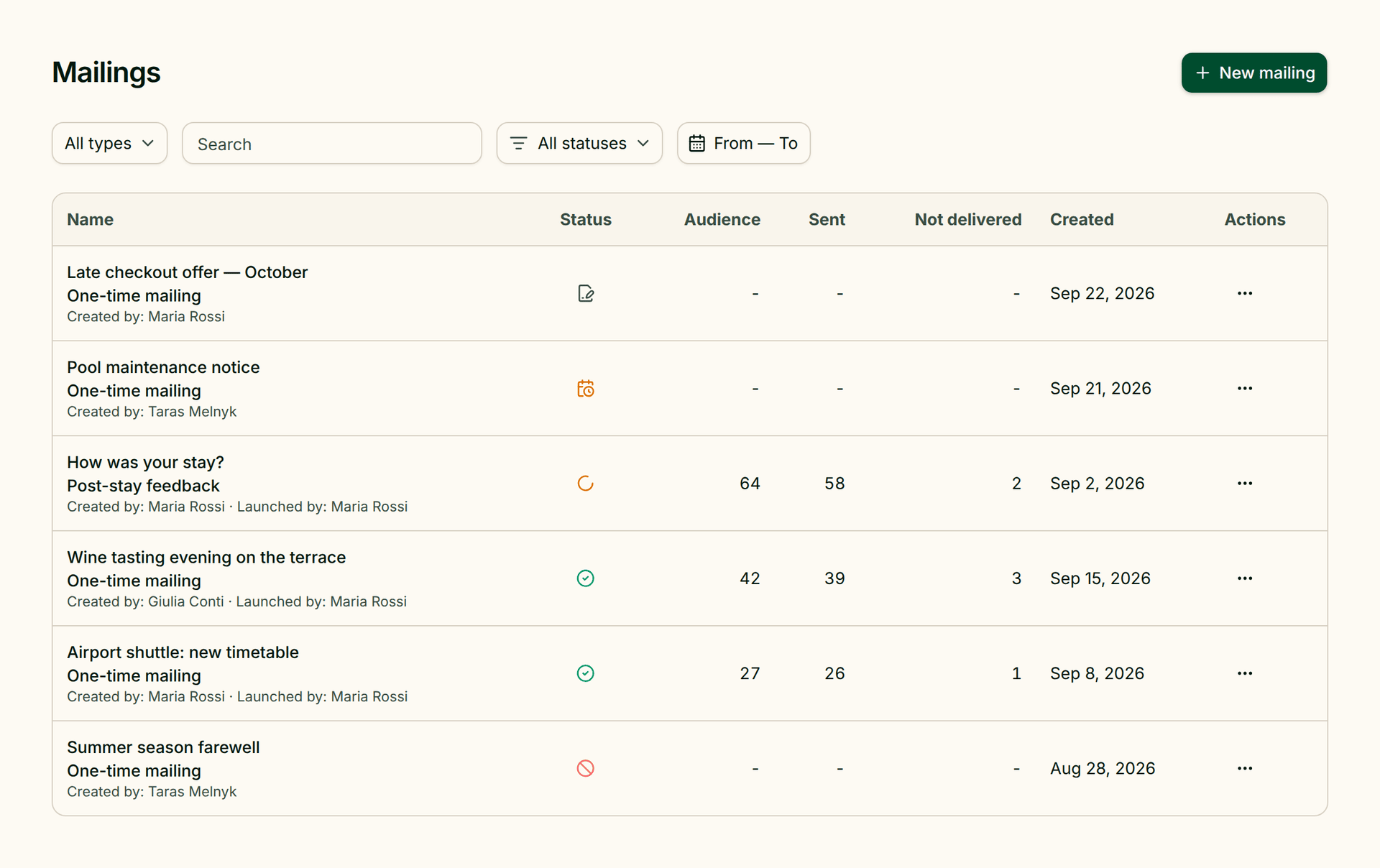
Feedback mailings run either on a trigger after checkout or as a one-off campaign, with the audience chosen before launch and the message localised per language. They go out on the messenger the guest already uses, not by email.
What you get, marked honestly
Live means it is running in production now. In build means exactly that.
Conversation satisfaction score — live
1 to 100 per conversation, scored nightly against a rubric, visible where your team already works.
Guest sentiment as a recurring job — live
Sentiment tracked continuously rather than sampled once, so a trend is a trend and not an anecdote.
Escalation on complaints — live
Complaints, money disputes and refund questions go to a person by rule, with the whole conversation attached.
Post-stay feedback mailings — live
Triggered after checkout or sent as a one-off campaign, with recipient selection, localised message variants and delivery statuses you can see per guest.
Review reply drafts — in build
Grounded in the stay's own record rather than in a template, and always approved by a person before publication.
Theme clustering — in build
Grouping recurring complaints so you fix a cause instead of answering a symptom twenty times.
Reputation tools versus starting during the stay
The same review, addressed at two very different moments.
| Classic reputation tool | Greetio | |
|---|---|---|
| When you find out | After the review is published | While the guest is still on the property |
| What you can do | Reply publicly | Fix it, then reply publicly |
| What the reply is based on | The review text | The conversation, the requests and what was actually done |
| Signal per stay | A star rating, at the end | A 1-to-100 score, during |
| Recurring problems | Read manually | Clustered (in build) |
Scenario: the review that did not get written
Second night of a four-night stay. The message arrives at 23:10.
- The complaint escalated to a person by rule, not by whoever happened to read it
- The conversation's satisfaction score dropped and stayed visible until it was resolved
- The stay ended with a room change instead of a one-star review about noise
The escalation, the scoring and the task in this scenario work today. Drafting a reply to a published review is the part still in build.
Want to see Greetio on your property?
Three fields, and we'll show how it works at your hotel.
The cheapest review to handle is the one nobody posts
A published bad review costs a reply, a discount and a permanent line on your profile. The same complaint, caught on the second night, costs a room change and a breakfast. Everything on this page is built around moving the moment of detection earlier — because that is the only point at which reputation work is still cheap.
- Live: satisfaction score per conversation, sentiment tracking, rule-based escalation
- In build: drafted replies to published reviews and complaint theme clustering
- Never: fabricated reviews, imported ratings or review gating — none of that is on the roadmap
We used to find out how a stay went when the rating arrived. Now we find out on night two, while it can still be fixed.
Reputation and reviews: what people ask
Live: a 1-to-100 satisfaction score per conversation, guest sentiment as a recurring job, rule-based escalation of complaints and money disputes, and post-stay feedback mailings — triggered after checkout or sent as a one-off campaign. In build: drafted replies to published reviews and clustering of recurring complaint themes.
No. The intention is a draft grounded in that stay's record, approved by a person before it goes anywhere. Automatic public replies about a guest's experience are not a risk worth automating.
We will publish platform coverage when it ships rather than listing integrations we have not finished. What already works is independent of any platform: it reads your own conversations.
Yes, this shipped. Feedback mailings run either on a trigger after checkout or as a one-off campaign, with the audience selected before launch and the message localised per language. They go out on the messenger the guest already uses. Review gating — asking happy guests publicly and unhappy ones privately — is not something we will build; most platforms prohibit it.
A nightly job scores each conversation from 1 to 100 against a rubric. It reflects the conversation, not a survey, so it exists for every guest who wrote to you rather than only for the few who answer a form.
That is the point of scoring during the stay. A conversation trending badly is visible in the inbox and the underlying request can be assigned as a task with an owner and a status.
Leave a request on this page for early access. In the meantime the scoring, sentiment and escalation half is available on your plan today.

Want to see Greetio on your property?
We'll show how AI replies from your data, which channels to connect first and how to launch onboarding.
Explore Greetio by use case
Start catching the bad review on night two
The scoring and escalation work today. Join early access for the review workflows.
Get early access