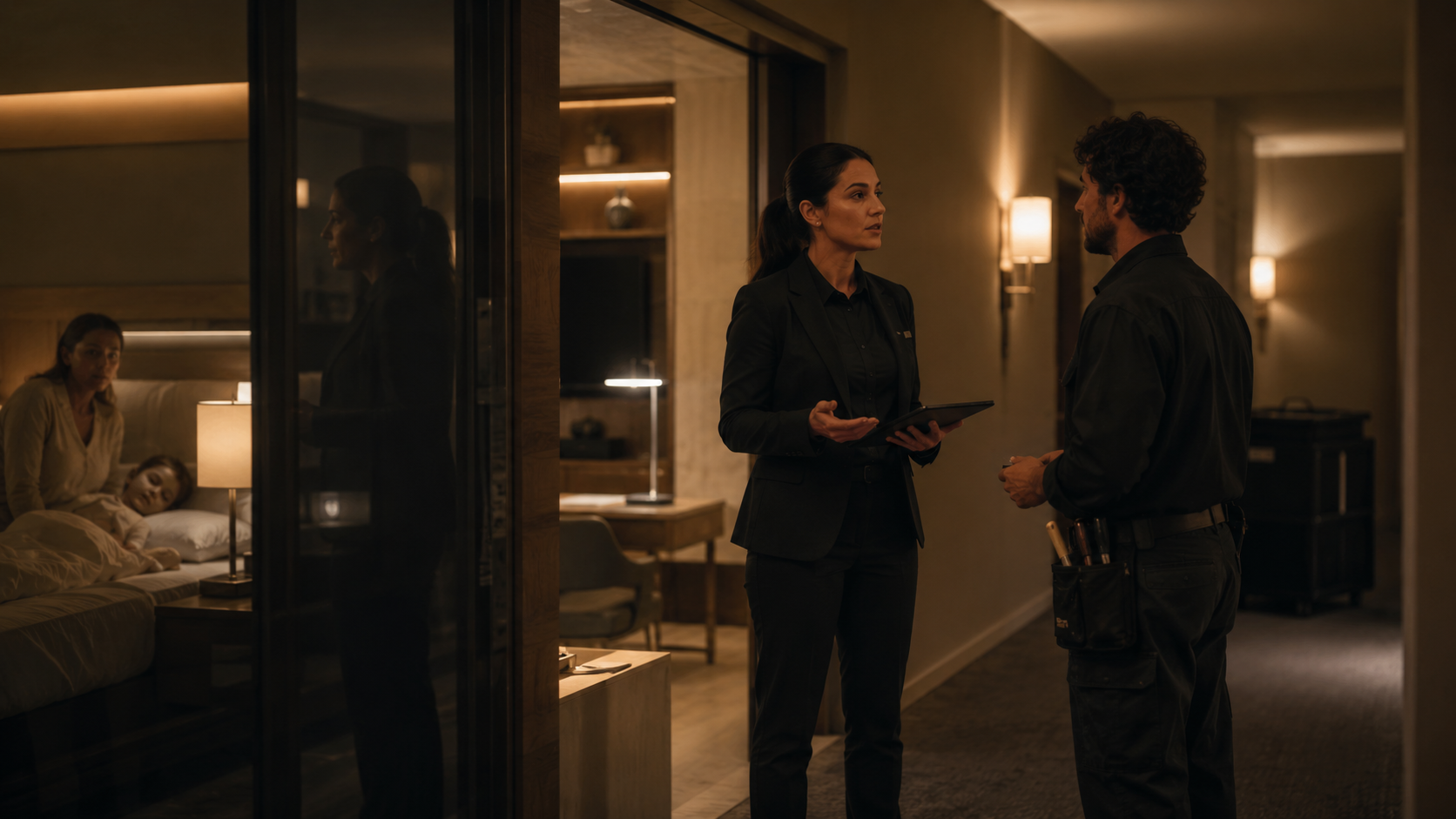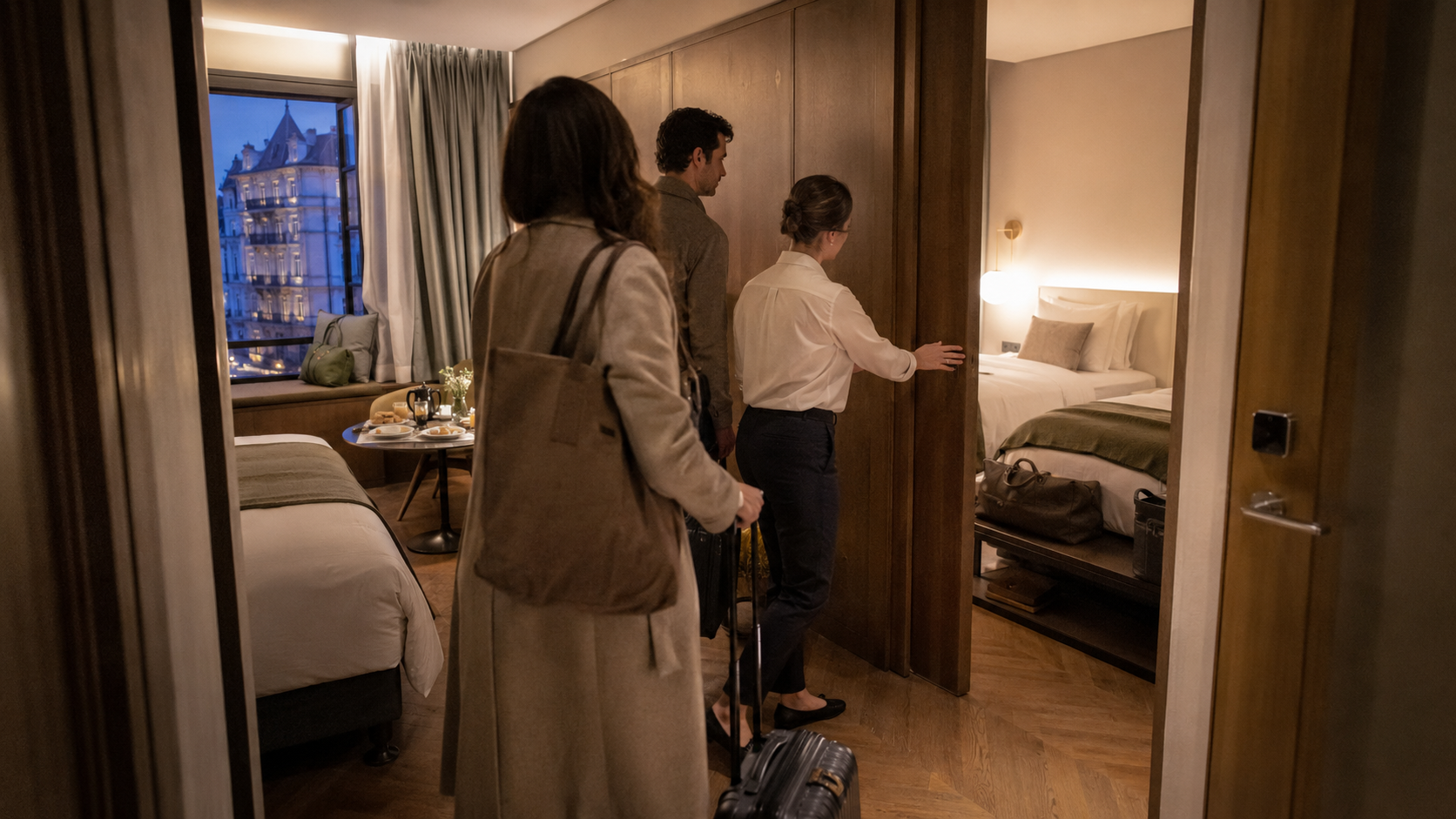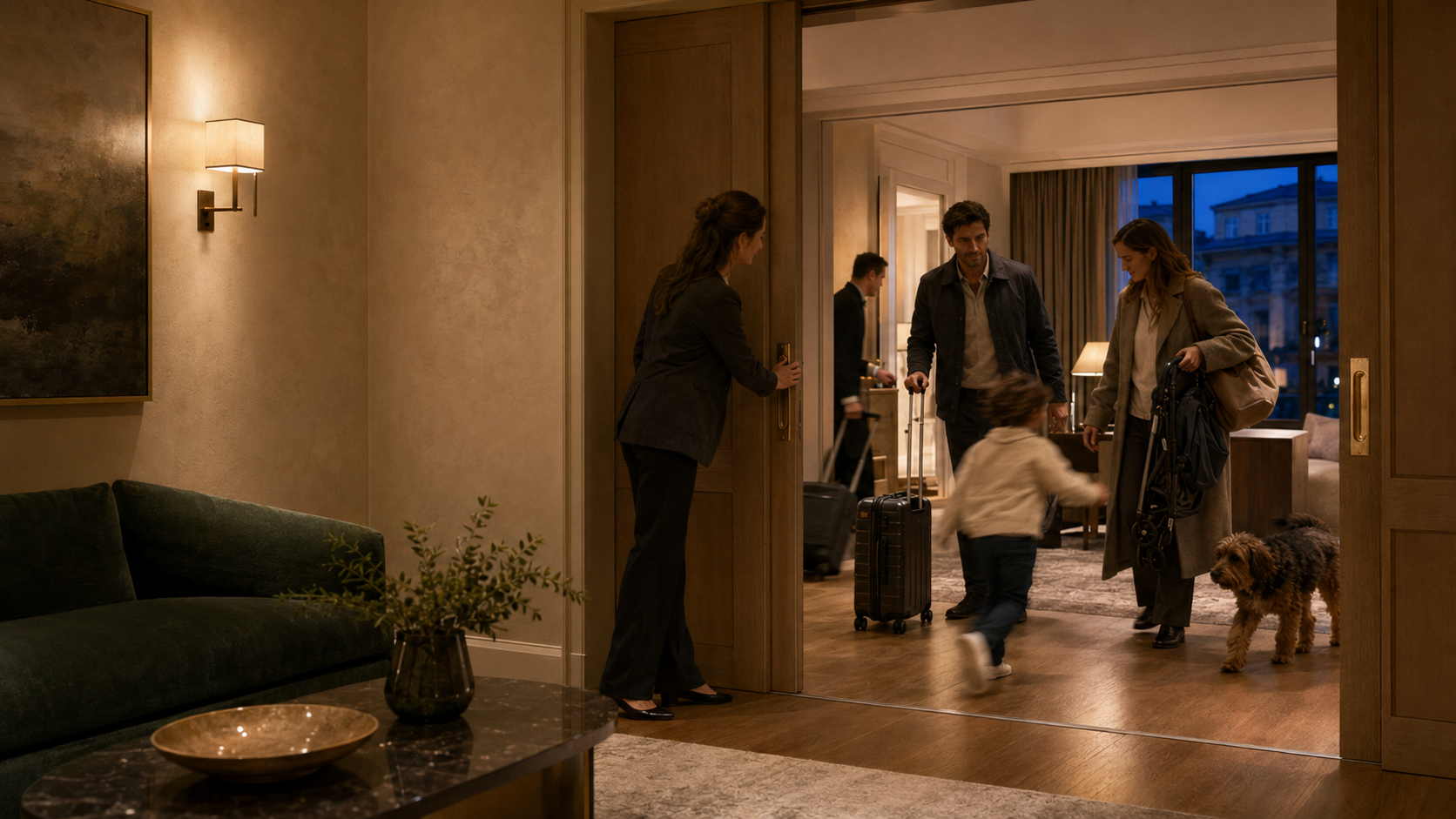

A hotel host opens a connecting room for a family arriving in the evening with a child, dog and luggage.
At 9:47 p.m., a hotel receives a short Instagram message:
“Good evening. We need a room for 20–22 August: two adults, our seven-year-old and a 9 kg dog. Can we have twin beds? Is there parking? And what is the final total with breakfast?”
The guest never uses the word “book”. Yet the dates, party and three decision conditions are already visible. Treat them as unrelated FAQs and the answer can easily dissolve into a few yeses, a policy link and an instruction to check the website. Treat them as conditions of a decision and the hotel can assemble one verified offer and open a short path to booking.
A high-intent message is not necessarily an explicit request to book. It is often the last uncertainty a guest wants to remove before choosing.
First, an important boundary: this is not a global ranking
No open industry dataset establishes that the same seven message formulations have the highest booking rate at every hotel. Property type, season, market, channel, price, availability and response quality all change the result.
The categories below are therefore a practical taxonomy of readiness signals, not a statistical top seven. They cover messages that already contain a concrete trip, a non-negotiable condition, a shortlist or a request for the next action. Each hotel must establish its own order using conversations linked to confirmed and uncancelled bookings.
The channel-level economics show why that work matters. SiteMinder’s 2025 Hotel Booking Trends, based on more than 135 million reservations across 20 markets, found direct bookings among the top three revenue sources in 90% of the markets analysed. Hotel websites generated an average booking value of US$516, compared with US$312 through online travel agencies. That does not prove that a particular message caused a purchase. It does show why the direct path from a question to a completed action deserves protection.
Intent, urgency, value and risk are not the same thing
The label “hot lead” conceals distinctions that matter operationally. A hotel should assess at least four separate dimensions when routing a message:
intent — how close the guest is to choosing and paying;
urgency — how quickly the hotel must act before the opportunity disappears;
potential value — the revenue and relationship value the enquiry may carry;
risk — the consequence of an inaccurate answer or an unverified promise.
“Do you have a room tonight?” is highly urgent but may be a one-night stay. An enquiry for 18 rooms may be highly valuable while taking weeks to decide. A question about a roll-in shower needs exact confirmation even if the guest is still comparing properties.
Priority is not one score. It is a decision about who should respond, by when, which source should verify the fact and whether the case can proceed without a person.
Four parts of a response that advances the decision
Across all seven categories, a useful response usually contains four components:
A direct answer to the main condition in the first sentence.
Only the clarification that is essential to produce an accurate option.
A verified price, rule or attribute from a defined source.
One relevant action: choose the room, open a prepared page, pay, or move to a staff member who already has the context.
The guest does not need a presentation of the whole hotel. They need the specific uncertainty removed without re-entering information they have already provided.
Message type | What it often means | Best next action |
|---|---|---|
Exact dates and availability | The trip is already concrete | One or two suitable options with a full total |
Comparing a room or rate | A shortlist already exists | A recommendation based on 2–4 decisive differences |
Total price, payment, cancellation | The guest is testing budget and risk | Transparent terms and a secure path to action |
Critical stay requirement | The trip may fail without it | Factual confirmation or a staff handoff |
Arrival and local logistics | The hotel fits, but the journey is unresolved | Confirm hours, cost and process |
Multiple rooms, long stay, event | High potential value and complex terms | An accepted handoff to a named owner |
Request to complete the booking | Intent is explicit | Confirm the choice and enable payment without detours |
1. Exact dates, party and availability
“Do you have a room from 18 to 20 September for two adults and a seven-year-old?”
“We need two rooms next weekend. Is anything available close together?”
This is one of the clearest signals of intent: the guest has defined the dates and the travelling party. The question is no longer about the hotel in general; it is whether a particular stay can happen.
What to answer. If live availability is accessible, offer one or two room categories that genuinely fit the party, the full stay total, inclusions and the key rate conditions. If a child’s age changes occupancy or pricing, ask that one essential question; do not ask for the dates and adults again.
Next step. A prepared page with the dates, party and recommended category already populated. Sending the homepage with “all prices are on our website” returns work the guest has already completed.
When a person is needed. Connecting rooms, unusual child occupancy, a guaranteed bed configuration, an exception request, or inventory that is not synchronised in real time.
2. Comparing two rooms or rate plans
“What is the difference between the Superior room and the Junior Suite?”
“Which is better for us: breakfast included or free cancellation?”
This guest has often narrowed the choice to two options. They do not need descriptions of every category; they are testing whether the difference is worthwhile for this trip.
What to answer. Compare the options on the two to four attributes that change the decision: total price, size and location, beds and extra occupancy, food, view, workspace or change terms. Tie the recommendation to known context: “For two adults and a child, the Junior Suite is more practical because it has a separate sitting area and a full-size extra bed.”
Next step. One recommended option and, if useful, one alternative. A long catalogue recreates the choice problem.
When a person is needed. A corporate agreement, loyalty benefit, special promotion or a different third-party rate the system cannot verify.
3. Total price, payment and cancellation
“What is the final total including taxes?”
“When will you charge the card, and until when can I cancel?”
“Can we change the dates if our flight moves?”
The guest is testing the risk of the decision as much as the price. In Expedia Group’s 2025 Traveler Value Index hotel snapshot, based on 11,000 respondents across 11 markets, low price and positive reviews each accounted for 18% of stated hotel-booking values; a full refund accounted for 13% and flexible changes for 11%. These are stated preferences, not measured chat-to-booking conversion, but they help explain why an answer about terms can be decisive.
What to answer. State the full amount and currency, included taxes and mandatory charges, deposit amount and timing, the free-cancellation deadline with time zone, the late-cancellation penalty and the no-show terms. If flexible and non-refundable rates are available, compare the full total and risk—not only the nightly rate.
Next step. The specific rate with the relevant conditions and a secure booking or payment page. Card details should not be collected in an ordinary chat.
When a person is needed. Refund exceptions, disputed charges, payment errors, gift certificates with unusual rules, or changes to an already-paid reservation.
4. A critical stay requirement
“Can we stay with a 9 kg dog?”
“Is there a step-free route to the room and a shower without a high lip?”
“We must have twin beds.”
These questions are easily downgraded to “special requests”. In reality, the stay may be unsuitable or impossible if the condition is not met.
What to answer. Provide concrete facts: pet restrictions, surcharge, doorway or route constraints, steps, shower design, actual bed configuration and whether the feature can be guaranteed. “We will note your preference” is not confirmation.
For accessibility, allergies, safety or medical needs, do not infer what the person requires or collect sensitive details “just in case”. The European Commission’s explanation of data minimisation describes limiting collection to data that is adequate, relevant and necessary for the stated purpose.
Next step. Offer a room that meets the condition and record the confirmed feature with the booking. If verification is required, give the guest a realistic time and a named owner.
When a person is needed. Accessibility, allergies, unusual occupancy, safety questions and any guarantee that is absent from a verified source.
5. Arrival and local logistics
“Our flight lands at 11:40 p.m. Can we check in after 1 a.m.?”
“Do you have parking, and should we reserve a space?”
“Can you arrange an airport pickup?”
A logistics question often appears after the property itself has passed the guest’s test. The remaining uncertainty is whether arrival and check-in will be safe and practical. In the same Expedia Group study, high-speed Wi-Fi and a hotel restaurant were leading amenities, while free parking, breakfast and airport transfers appeared among perks that encourage booking. The importance of any one service still needs to be validated against the hotel’s own audience.
What to answer. Start with a clear yes, no or “requires confirmation”, followed by hours, price, advance-booking requirements, capacity and constraints. For late arrival, explain entry, contact details and what to do after a delay.
Next step. Add the service to the offer or hand the request to someone who can confirm it. “No problem—just come” is dangerous when the night entrance closes or an external supplier operates the transfer.
When a person is needed. Arrival outside established hours, private transport, limited parking, a large party, unaccompanied minors or a last-minute time change.
6. Multiple rooms, a long stay or an event
“We need eight rooms for wedding guests for three nights.”
“We are looking for accommodation for a film crew for two weeks.”
“Can you host a team of 24 and arrange dinner?”
This enquiry may not reach payment today, but its potential value can be far higher. The mistake is forcing the organiser to book every room separately or leaving the request in a queue of simple questions.
What to answer. Collect only the minimum needed for a qualified handoff: dates, approximate rooms and guests, occupancy preferences, food or meeting requirements, proposal deadline and a contact for the next stage. Do not turn the first response into a long questionnaire when some details can wait until availability is checked.
Next step. A named handoff to sales or the responsible manager, with a short summary, all known conditions and a response deadline. “Transferred” should mean that a specific person accepted responsibility—not merely that a notification was sent.
When a person is needed. Almost immediately once the case is confirmed as a group, corporate stay, event, extended stay or request for negotiated terms.
7. A direct request to complete the booking
“That works for us. Please send the payment link.”
“Can you hold this room until this evening?”
“I want this option. What do I do next?”
Intent is now explicit. The common mistake is to keep selling, introduce more options or restart data collection instead of helping the guest complete the action.
What to answer. Briefly confirm dates, category, party, full total and material terms. Then provide a secure booking or payment path. If a temporary hold is possible, state the deadline, time zone and conditions. If it is not, do not imply the room has been reserved.
Next step. Completion without extra redirects or re-entering known information.
When a person is needed. The system cannot create the correct path, the price has changed, an exception is requested, payment fails or a room hold requires manual confirmation.
One message can carry several signals
“We arrive after midnight tonight, we have a dog—can we pay now?” combines at least three categories: logistics, a critical stay condition and a request to complete the action. One coarse label would be unsafe.
A more useful record captures:
the primary intent that determines the next action;
additional decision conditions;
known parameters such as dates, party, room and rate;
urgency, potential value and risk;
the fact, its source and the last verification time.
Google Cloud Dialogflow’s intent documentation usefully separates intent, parameters and conversational context. It is not a hotel model or evidence of booking conversion, but it provides a sound technical cue: preserve structured conditions and dialogue history, not just a label for one utterance.
In this example, the pet policy and the night-arrival process must be confirmed before payment becomes a safe next action.
How to measure message types without fooling yourself
Start with a manual review of 100–200 recent conversations over a continuous period, not with automatic classification. The unit of analysis should be an enquiry or conversation, not each individual message. Have two staff members independently label a random subset and reconcile disagreements; otherwise, the system will learn to reproduce unclear human labels.
A minimum event chain is:
qualified enquiry → verified offer → booking started → booking confirmed → booking uncancelled or stay completed.
In Google Analytics’ official recommended event reference, lead creation or qualification, checkout start and purchase are separate events; purchase also carries a unique transaction identifier that helps prevent duplicate counting. This is not a hotel standard, but it is a useful reminder that an open conversation, a sent offer and confirmed payment are different outcomes.
For each category, track:
time to the first substantive, not automatic, response—both median and 90th percentile;
the share of enquiries with sufficient context and a verified offer;
offer-to-booking-start and offer-to-confirmed-booking rates;
accepted handoffs and time to action by the named owner;
known outcomes and reasons for valid exits;
revenue per qualified enquiry after cancellations, where the data permits.
Use two denominators: all qualified enquiries and those for which a suitable room was actually available. Sold-out inventory should not look like poor team performance. Give group enquiries a longer evaluation window than one-night stays. And do not claim that “this message type created the booking”: it may simply reveal readiness built by advertising, reviews, price and earlier research.
Where Greetio helps
In this model, Greetio can identify primary and secondary intent, extract dates, party and decision conditions, retain known context, prepare an answer from verified rules and offer the relevant action. When a person is required, the conversation should move with a concise summary, the unresolved question and a deadline.
Live availability, price, rate rules and service confirmation must, however, come from connected sources. Without that access, the system should not invent a fact. The correct action is to state what needs verification, collect the minimum required information and route the case to an accountable person.
That requirement reflects the broader market. In the h2c 2025 AI & Automation Study, 45% of responding hotel-chain representatives named integration challenges among the leading barriers, while proven revenue-growth impact was a top investment factor at 69%. Personalised booking experiences and upselling were also among the leading planned guest-experience initiatives. The sample represents chains and should not be generalised mechanically to every independent property, but it illustrates the point: value comes from connected data, rules and next actions—not from the AI label itself.
Conclusion
A message that leads to a booking does not always contain the word “book”. It may be a simple question about parking, beds, the final total, cancellation or late arrival. What sits behind it is often the final condition of the decision.
The seven categories in this article are a working map, not a global league table. Their value begins when the hotel validates the map against its own data—through confirmed and uncancelled bookings, not merely clicks or closed conversations.
Take 100–200 recent conversations. Mark the primary intent and secondary conditions, find answers with no clear next action, and identify where guests must repeat known information. That is where an unused opportunity most often remains.
Greetio can help turn these enquiries into a managed process: retain context across connected channels, use verified sources and involve staff at the right boundary. The goal is not to automate every reply. It is to avoid losing the moment when a question has already become a decision.