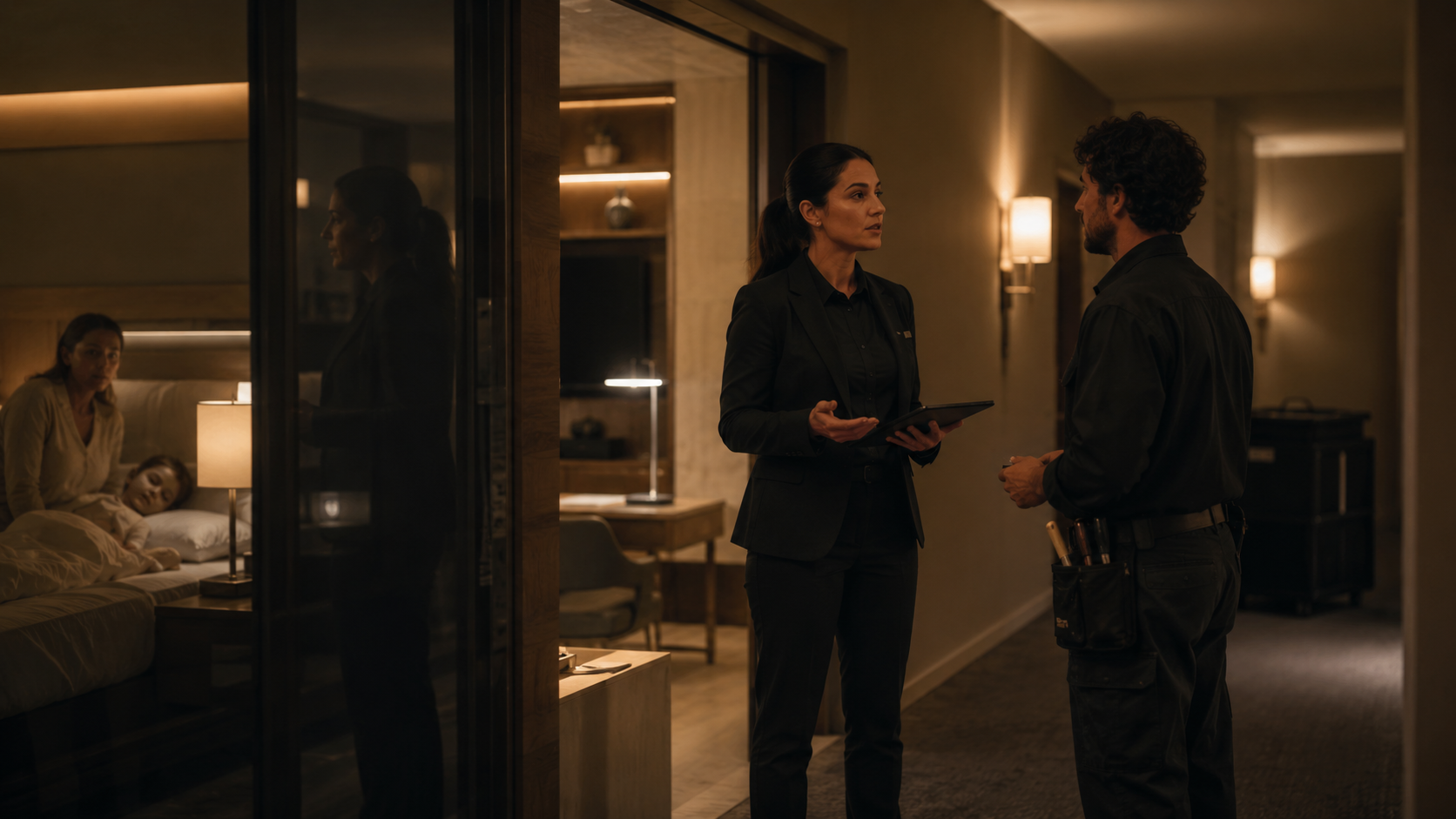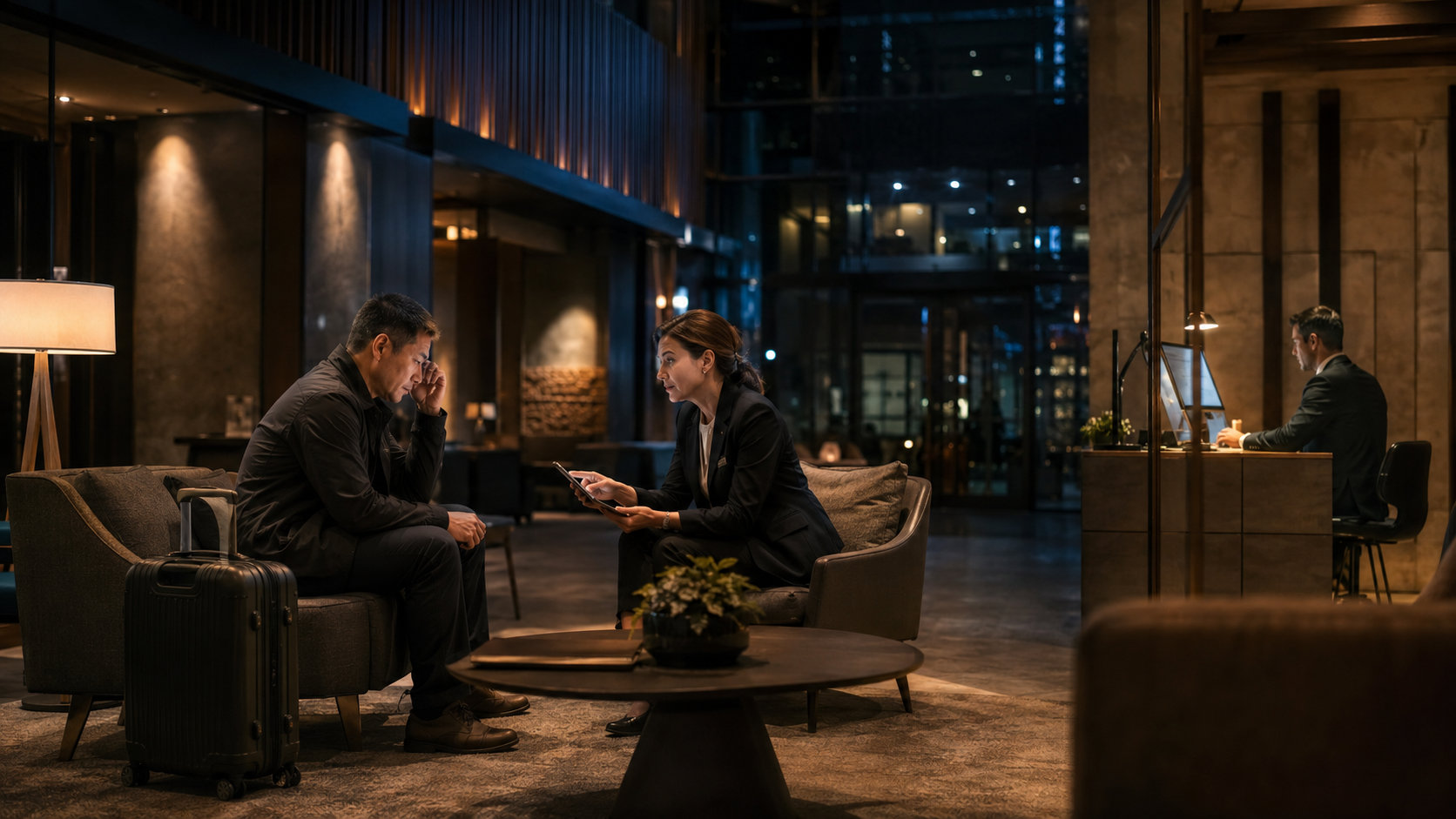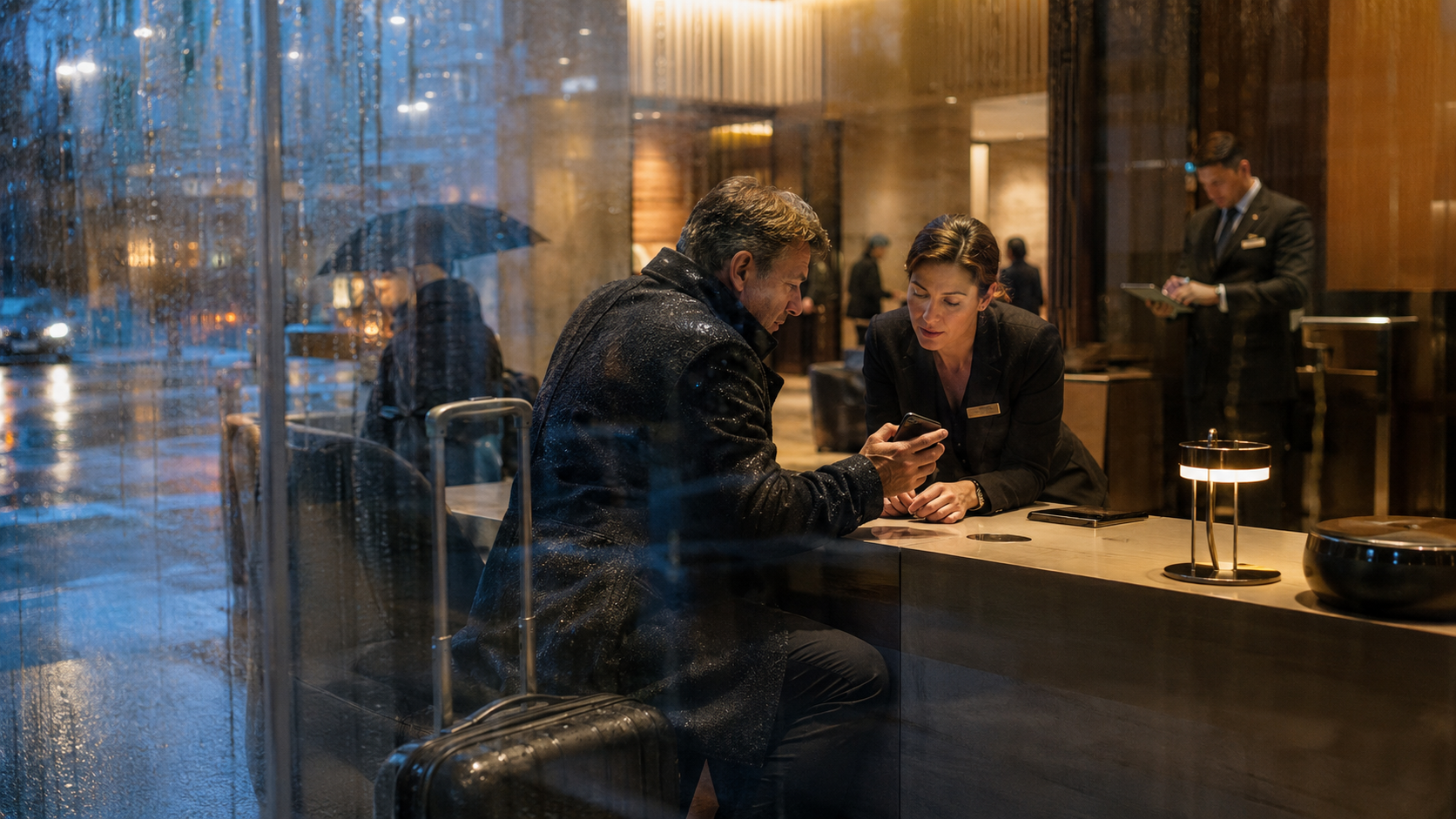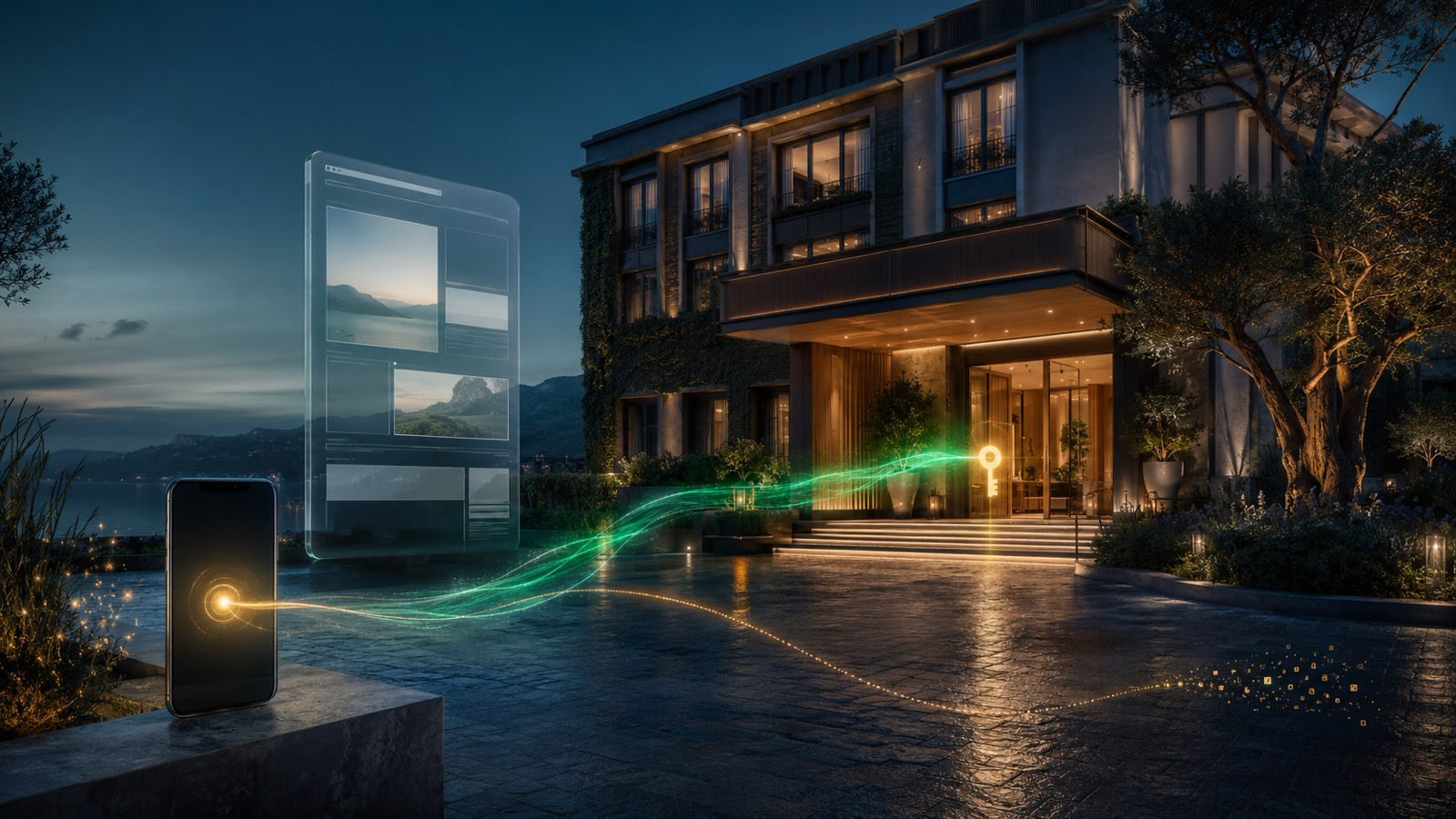

The hotel has just launched a redesigned website. New photographs capture the atmosphere, the room pages look compelling, and the booking engine works without unnecessary steps. At 9:47 p.m., a visitor writes in the chat: “I need a room for two adults and one child from 16 to 18 August. Is parking available, and can we arrive after 11 p.m.?”
She is almost ready to book. But the website does not explain whether a seven-year-old needs a separate bed, whether a parking space can be guaranteed, or how to arrange a late arrival. By morning, the message still has no substantive answer. Meanwhile, another hotel asks one clarifying question, confirms the relevant policies, and sends the right next step.
The first hotel did not lose the booking because of weak design. It let already-earned booking intent slip away at the moment the guest needed clarity to make a decision.
A website creates trust and desire. A fast, substantive response preserves the guest’s intent and turns it into action. Once the first question is asked, communication becomes an extension of the direct sales channel.
This is not an argument against a high-quality website. A slow, confusing, or uninspiring website can damage bookings too. But the moment someone contacts the hotel, a different stage begins: the task is no longer to present the offer, but to remove a specific obstacle between intent and payment.
A beautiful website sells the promise. A response reduces decision risk
A website works best with information that many guests have in common: it presents rooms, location, services, policies, prices, and a picture of the future stay. Its job is to spark interest, build trust, and help someone begin choosing.
Questions arise when general information is no longer enough. “Will a cot fit in the room?”; “Can we still have breakfast if we leave early?”; “Is wellness centre access included in this rate?”; “Is the prepayment refundable if our flight is cancelled?”
These enquiries often contain more than a request for information. They reveal an unresolved condition of purchase. That is why a delay after a question feels different from one more second spent browsing a page. The guest has already invested attention, described the circumstances, and now expects the hotel to help them reach a decision.
At that point, the hotel is competing with more than another property. It is competing with any path that removes uncertainty faster: an online travel agency with a clear filter, another hotel that replies through a messaging app, or the decision not to travel at all.
Direct booking runs on two clocks
The first clock is technical. A page should load quickly, respond to interactions, and remain visually stable. Google Web Vitals recommends a Largest Contentful Paint (LCP) within 2.5 seconds and an Interaction to Next Paint (INP) within 200 milliseconds. Those thresholds are assessed at the 75th percentile, separately for mobile and desktop devices. These are useful, measurable benchmarks: visual polish does not compensate for technical friction.
The second clock is operational. It starts when the guest clicks “Send”. From that moment, the hotel should measure not the page, but its ability to:
notice the enquiry in the right channel;
identify intent and urgency;
find a verified answer;
ask only the necessary clarifying question;
provide a useful next step;
involve an employee in time when automation is not authorised to resolve the issue.
Hotels often see the first clock clearly in web analytics and barely see the second, because messages are scattered across website chat, email, social media, messaging apps, and employees’ personal phones.
As a result, marketing can report traffic and clicks into the booking engine, while the operations team reports the number of messages handled. Between those reports lies an invisible gap: how many guests were already ready to book, but waited for an answer longer than their decision window remained open.
What the data says — and what it does not prove
SiteMinder analysed more than 135 million bookings made in 2025 across 20 destinations. According to the platform’s data, bookings through hotel websites had an average value of US$516, compared with US$312 through online travel agencies. The direct channel ranked among the top three revenue sources in 90% of the markets studied.
This does not mean that a fast response creates the US$204 difference by itself. Average booking value is not the same as net profit, and guest mix and length of stay vary by channel. The data does, however, show the economic scale of the risk: an enquiry on a hotel’s own website or through another direct channel may precede a particularly valuable booking.
Zendesk CX Trends 2026 reports that 88% of surveyed customers expect faster responses than they did a year earlier, while 74% expect service to be available around the clock because of the rise of AI. Its methodology covers 6,182 consumers and 5,115 customer experience professionals across 22 countries. This is a cross-industry study by a technology provider, not a hospitality benchmark. It is best read as a signal that expectations are changing, rather than proof of a specific uplift in bookings.
Back in 2011, the authors of a Harvard Business Review study on online sales leads concluded that most companies were not responding quickly enough. The data is old and comes from another market, so it should not be turned into a hospitality standard. The management principle matters more: delays should be compared with enquiry outcomes, not discussed only as a matter of perception.
For any individual hotel, the most reliable answer should come from its own data: what proportion of substantive enquiries leads to a booking at different response times, by channel, time of day, topic, and employee involvement.
Speed without substance is a misleading metric
An automated “Thank you, we have received your message” sent in three seconds improves the technical first-response time, but it does not reduce the guest’s uncertainty. Equally, a long and flawless response sent six hours later may arrive after the decision has already been made.
It helps to separate four time metrics:
Time to acknowledgement — the guest knows the message has not been lost.
Time to first substantive response — the guest receives verified information or a necessary clarification that genuinely moves the conversation forward.
Time to next action — a relevant booking link, prepared offer, request for required details, or handover to the responsible employee appears.
Time to resolution — the question is actually closed, the booking is completed, or the request is fulfilled. Time until a human accepts the handover should be measured separately.
Before a booking, the central metric is time to first substantive response, not time to the first automated sentence.
Response type | Example | What happens to guest intent |
Fast but empty | “Thank you for contacting us. A manager will reply later” | Receipt is acknowledged, but the obstacle to a decision remains |
Correct but late | A detailed response the next morning | The information is good, but the decision window may already have closed |
Fast and substantive | A confirmed policy, one necessary clarification, and a clear next step | Uncertainty decreases and the conversation moves towards an outcome |
Fast but wrong | Invented availability, price, term, or policy | The decision accelerates in the wrong direction, creating financial and reputational risk |
This can be expressed as a management model, not a statistical formula:
Response value = timeliness × accuracy × relevance × next step. If any one factor approaches zero, speed alone cannot rescue the outcome.
Where hotels most often lose time
Messages live in separate inboxes
Website chat, Instagram, Facebook, WhatsApp, Telegram, Viber, and email may all have different owners. In the evening, an employee may see only some channels; after a shift change, an enquiry may have no owner; the conversation history may remain on someone’s personal phone.
The delay begins before anyone even reads the message. Adding another channel without a shared workspace can therefore improve access for the guest while reducing control for the hotel.
Every enquiry enters the same queue
An enquiry with exact dates and guest numbers may wait next to a general question about the distance to the city centre. If the queue is managed only by arrival time, the hotel cannot distinguish strong booking intent from general information gathering.
Prioritisation does not mean ignoring other messages. It means recognising where a delay is most likely to become lost revenue, a service failure, or a safety risk.
Employees reconstruct each answer from scratch
Even an experienced manager loses time when cancellation policies are stored in one document, parking conditions are buried in an old conversation, and the current package inclusions must be confirmed by phone. The problem is not typing speed, but the quality and accessibility of internal knowledge.
A fast response leads to a dead end
“All prices are on the website” or “Please complete the form” may be factually correct, but it makes the guest restart the journey. The answer should retain the dates, guest numbers, and concern already provided, and carry them into the next step.
Human handover restarts the conversation
In the same Zendesk study, 74% of respondents said having to repeat their situation to different employees was frustrating. If a manager follows an automated response by asking again for the dates, number of guests, and reason for the enquiry, a technically fast first contact creates a long path to resolution. A good handover includes a concise summary, known details, the unresolved question, and the reason a person is needed.
The architecture of a fast, substantive response
Speed should not be built around an instruction to “reply faster”. It requires a five-part process.
1. Identify intent and risk level
The system or employee must distinguish a pre-booking enquiry from an existing booking, a service request, or a sensitive situation. Price, availability, complaints, refunds, and safety issues require different rules and different owners.
2. Establish the source of truth
For each topic, the hotel needs to know where a verified answer comes from: the knowledge base, booking engine, property management system, internal calendar, approved policy, or responsible department. If the data is outdated or unavailable, the system should say that a check is required and hand the enquiry over, rather than fill the gap with plausible-sounding text.
NIST’s Generative AI risk management profile specifically describes the risk of confident but false responses. For a hotel, this matters particularly for prices, availability, payments, and policies. Rapid wording must never take priority over a reliable source and clear limits on automation.
3. Compose the minimum useful response
The first substantive response does not need to be long. It should:
answer directly what can already be answered;
state what needs to be checked;
ask no more questions than are necessary to continue;
avoid repeating details the guest has already provided;
set expectations if an employee needs time to respond.
4. Add one relevant next step
That step could be an availability check, a choice between two rates, a pre-filled direct booking, secure payment, a call from reservations, or confirmation of a task by the front desk. Not every conversation needs the same call to action.
5. Transfer context and confirm acceptance
A handover is not complete when the system changes a message status. It is complete when the responsible employee receives the context, accepts the enquiry, and knows the response deadline. If that does not happen, the fast automated stage merely conceals a new delay.
A practical scenario: the 9:47 p.m. enquiry
Return to the question about two adults, one child, parking, and late arrival.
A weak but fast reply:
“Thank you! Please check rooms and prices on our website. A manager will contact you.”
It uses none of the information already supplied and resolves none of the guest’s concerns.
A substantive response without live access to availability data might read:
“Thank you, I have your dates and guest details. Arrival after 11 p.m. is possible if you let us know your estimated arrival time in advance. Parking is subject to availability, so I will ask the front desk to confirm a space specifically for 16–18 August. Could you please tell me whether the child needs a separate bed? I will then send the appropriate option and a direct booking link.”
If the hotel has reliable connections to rates and availability, the reply can immediately offer suitable room categories and carry the known parameters into the booking engine. If it does not, it should arrange an honest check. In both cases, the guest understands what is known, what is being confirmed, and what will happen next.
Speed creates value here not by itself, but by preserving context while intent is still active.
What to measure instead of “average response time”
An average can be improved easily with hundreds of instant automated greetings while complex, valuable enquiries wait for hours. A broader set of metrics is therefore needed.
Metric | How to calculate it | What decision it supports |
Median time to first substantive response | Half of enquiries received a useful response faster, and half slower | Shows the typical experience without being heavily distorted by isolated delays |
90th percentile | The time to first substantive response that 90% of enquiries did not exceed | Reveals the long tail that an average can hide |
Share of enquiries without a substantive response | Unhandled enquiries, those closed with only a greeting, or those lost after handover | Exposes direct gaps in the process |
Time to next action | From the first message to an offer, booking, payment, or accepted handover | Distinguishes a reply from genuine progress |
Outcome by response-time band | Booking rate for under 1 minute, 1–5, 5–15, 15–60, and over 60 minutes | Helps identify the hotel’s own window of sensitivity to delay |
Difference between staffed and unstaffed hours | The same metrics separated by coverage periods | Supports decisions about schedules, automation, and on-call coverage |
Delay after employee handover | From the handover decision to the first human action | Shows whether automation merely moves the queue elsewhere |
Conversation-associated direct bookings | Bookings preceded by a measured conversation within a defined window | Links communication to commercial outcomes without claiming that chat was the only cause |
Do not compare only automated and manual replies: more complex cases often enter the manual queue. For a fairer analysis, compare enquiries with similar intent, channel, time of day, complexity, arrival date, and room availability.
A diagnostic estimate of potential loss can be built by multiplying the number of enquiries in a slow response-time band by the difference in booking rates between comparable fast and slow bands. This does not prove causation — fast and slow enquiries may differ in other ways. But the estimate can show where a controlled experiment or process change is worth pursuing.
A practical 30-day plan
Week 1. Establish the baseline
Take at least 100 substantive pre-booking enquiries from all direct channels. Record the time, channel, known dates, intent, first substantive response, next action, human handover, and outcome. This is a diagnostic starting sample, not a guarantee of statistical reliability; hotels with low enquiry volume should use a longer period. Flag messages received outside staffed hours separately.
Week 2. Remove structural delays
Bring channels into one queue, assign owners and backups, and close the most common knowledge gaps. Do not automate a topic until it is clear which source is authoritative and when it is updated.
Week 3. Launch a limited workflow
Choose one repetitive, low-risk journey — for example, a room enquiry that includes dates. Configure intent recognition, minimum clarifying questions, a verified source, a direct next step, and conditions for employee handover. Initially, the system can prepare drafts so the team can validate accuracy.
Week 4. Compare outcomes
Compare response-time bands, the share of substantive responses, progression to the next action, bookings, and reasons for handover. Manually review a random sample of conversations. Only then should the hotel expand automation or set stricter response targets.
Where AI helps — and where it should stop
AI is particularly useful where delays result from volume, repetition, and fragmented channels. Around the clock, it can detect enquiries, identify intent, retrieve an answer from approved knowledge, collect dates and guest details, prepare the next action, and hand an employee a concise summary.
In h2c’s 2025 study, among the 146 respondents who answered the question on essential hotel-chatbot features, 85% selected handling guest enquiries and booking assistance, while 71% selected direct reservations through the chatbot. The overall study comprised 189 responses from representatives of 171 unique hotel chains. The sample mainly represents hotel chains, so it is not a universal picture of independent hotels. It does, however, show how the requirement is changing: the market needs more than a fast informational answer; it needs a link between response and action.
At the same time, AI should not guess a live price, guarantee an unverified parking space, make an exception to a policy on its own, resolve a payment dispute, or conceal uncertainty. In those cases, the best fast response is to acknowledge the limit honestly, collect the context, and transfer the question immediately to an authorised person.
The purpose of automation is not to minimise employee involvement. It is to stop spending their time searching for repetitive information while involving them sooner where a decision is required.
How Greetio fits this model
Depending on the connected channels and data sources, Greetio brings website chat, WhatsApp, Instagram, Facebook, Telegram, and Viber into one workspace. The system can prepare or send responses based on hotel data, collect booking details, check availability through connected sources, guide the guest to the next direct-booking step, and hand complex cases to an employee with the context intact.
The point is not “reply in seconds” as a marketing promise. The point is to manage the entire journey: from the arrival of a message to the first substantive response, the next action, the transfer of context to an employee, and the tracking of available outcomes.
That is why a hotel needs more than a standalone chat button on a beautiful website. It needs a managed communication layer that continues marketing’s work after the guest asks a question.
Conclusion
A beautiful website matters: it shapes the first impression, explains the offer, and builds trust. But it cannot anticipate every detail of an individual trip.
When a guest makes contact, the hotel receives a rare and valuable signal: this person is no longer simply browsing, but trying to remove an obstacle to a decision. If the response is late, empty, or offers no next step, the hotel’s marketing investment stalls in the final stretch.
Start by auditing the last 100 substantive pre-booking enquiries. Measure time not to a greeting but to the first useful answer; divide conversations into response-time bands; examine where context disappears and whether booking rates change. Treat this as an initial diagnostic, not statistical proof; use a longer period if enquiry volume is low. The analysis will show whether the main problem lies in the channel, knowledge, staffing, employee handover, or the absence of a next step.