
Hotels already have systems for rooms, rates, reservations and marketing. But which system owns the conversation between a guest’s first question and the action that follows?
A guest sends an Instagram message:
“Do you have a room for two this weekend? Is breakfast included? We will arrive after 11 p.m.”
For the guest, this is one question to one hotel. Inside the hotel, it may touch five different places: a social media inbox, room inventory, a rate plan, the late-arrival policy and reception’s task list.
Even a correct reply does not guarantee an outcome. A manager may confirm late arrival in the chat but fail to notify the night team. A social media employee may promise to check availability and lose the conversation among new messages. The guest may receive a booking link but still not understand which rate is right for them.
The problem is not one underperforming channel. Most hotels have no system that owns the entire conversational journey—from guest intent to a verified answer, a direct booking, an operational action or a deliberate human handoff.
At Greetio, we call this missing operating layer the guest communication layer.
This is not yet a formal hospitality technology standard, nor is it another name for a chatbot. It is a model proposed by Greetio for connecting guest messages, hotel knowledge, booking data, automation controls and department workflows into one continuous process.
Four transitions define the value of the layer: a message becomes context; a question becomes a verified answer; interest becomes a booking; a service request becomes a completed task.
The missing system between interest and booking
A hotel technology stack is made up of specialised tools. That is generally sensible: each tool was designed for a specific job.
The website publishes information and creates demand. The booking engine presents available options and completes a transaction. The property management system records inventory, rates, reservations, arrivals and departures. The customer relationship management system maintains profiles and supports repeat business. The channel manager synchronises availability and pricing across distribution platforms.
Before a guest is ready to enter card details, however, there is a field of questions, doubts and comparisons:
“Which room will be quieter?”
“What would work for two adults and a child?”
“Our flight lands after midnight. Can we still check in?”
“Why is the price different on another website?”
“Can we arrange an airport transfer and a spa treatment as well?”
These messages rarely fit a single FAQ script. A question about cancellation may mean the guest is comparing two hotels. A request for a cot may be the last obstacle before payment. Asking for a room recommendation often means the guest does not want to decode ten categories alone.
The communication layer helps the hotel understand more than the sentence. It identifies the decision the guest is trying to make and the next action required to support that decision.
It is not another name for a chatbot
A chatbot, website chat, booking engine and property management system can all take part in the same journey. None of them, on its own, performs the job of the guest communication layer.
Tool | Primary job | Where its job ends |
Hotel website | Explains the property and its offer | Does not hold a personal conversation or preserve context between channels |
Website chat | Gives visitors an entry point to a dialogue | Covers one entry point unless it is connected to a common workflow |
Chatbot | Automates some answers | A fluent answer without current data, action and control can remain an empty reply |
Booking engine | Shows availability and rates and completes a reservation | Is designed for a structured transaction, not the uncertainty that precedes it |
Property management system | Manages rooms, rates, reservations and stays | Is a system of record, not the conversational surface |
Customer relationship management system | Maintains guest profiles and interaction history | Does not necessarily coordinate live conversations and operational actions |
Guest communication layer | Connects intent, context, verified data, response and next action | Does not replace core systems; it orchestrates the journey between them |
The distinction is simple: a chatbot optimises the answer; a communication layer owns the outcome of the conversation.
The outcome does not always have to be a sale. It may be a clear answer, a request for missing information, escalation of a complaint to a manager or a housekeeping task. But the workflow cannot end simply because software has produced a polished sentence.
How the guest communication layer works
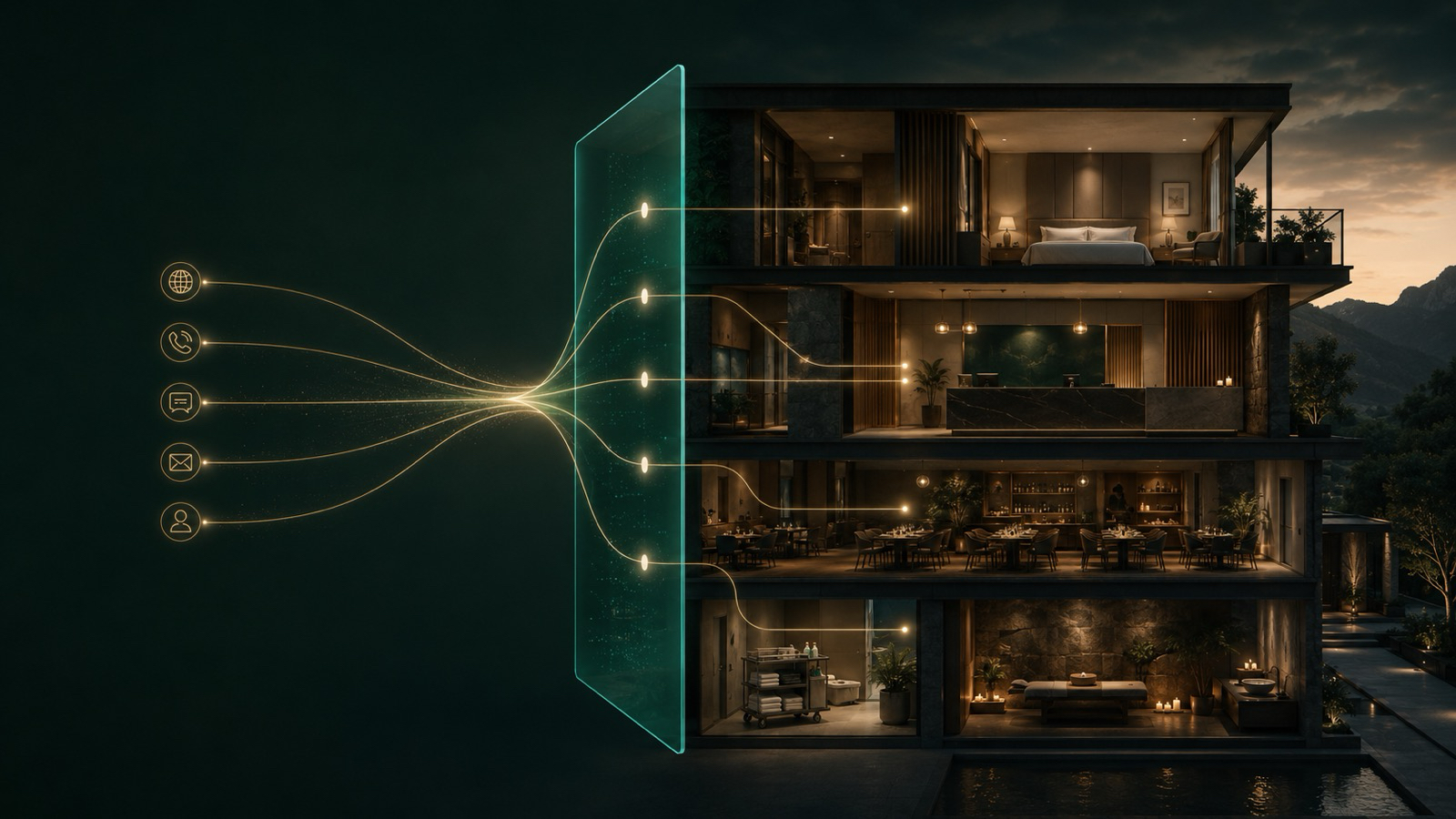
Think of it as the operating level between guest-facing channels and the hotel’s systems and teams.
At the entrance are website chat, WhatsApp, Instagram, Facebook, Telegram, Viber and other connected channels.
Inside the layer are conversation context, recognised intent, governed hotel knowledge, safety rules, levels of automation and next-action logic.
At the exit is a verified answer, a direct-booking step, a prepared reservation, an upsell, a task for the appropriate department or a human handoff with the full relevant context.
Seven capabilities make that layer operational.
1. Bring channels into one workflow
Guests should not have to know which team owns Instagram, who is on WhatsApp duty or where website messages are stored. To them, every touchpoint is the same hotel.
A shared workspace is not only a convenience. It reduces the chance that two employees give conflicting answers, that an enquiry disappears during a shift change or that strong booking intent remains trapped in one manager’s personal inbox.
Connected channels are not technically identical. Platform rules and available interfaces vary. The operational standard, however, should be consistent: the same approved knowledge, tone, escalation rules and ownership logic should govern every supported channel.
2. Preserve intent and context
One message rarely contains everything the hotel needs. The layer should understand that “What about breakfast?” refers to the rate just discussed, while “Could it be later?” may refer to check-in or check-out depending on the conversation.
Context is more than a transcript. It includes dates, party composition, the room under consideration, the guest’s stage of decision-making, policies already checked, internal notes and promises the hotel has made.
Without context, automation repeats questions and produces contradictory replies. Employees waste time reconstructing the same history.
3. Answer from governed hotel knowledge
Artificial intelligence can state an error persuasively. In hospitality, that is particularly dangerous: an invented rate, a misrepresented cancellation policy or unverified availability costs money and trust.
Answers therefore need to be grounded in approved room descriptions, policies, rates, services, offers, schedules and availability sources. Critical information needs an owner, a review date and a clear update process. If two documents contain different check-in rules, technology cannot responsibly guess which one management intended.
A hotel-focused communication layer is not a general-purpose assistant with a hotel logo. Its authority comes from controlled property data and explicit limits.
4. Distinguish auto-send, review and handoff
Not every topic carries the same risk. Standard breakfast hours may be suitable for an automatic reply when the source is current. A cancellation exception, payment dispute, accessibility question or serious complaint needs a person.
A mature layer does not force a hotel to choose between fully manual work and unrestricted automation. It supports three modes:
automatic responses for verified, low-risk topics;
drafts reviewed by an employee;
immediate handoff when the system should not attempt an answer.
The system’s ability to decline to answer without enough evidence is a reliability feature, not a weakness.
5. Connect the conversation to booking
A booking engine works well when the guest already knows the dates, party size and desired room category. The communication layer works earlier: it clarifies the need, explains the difference between rates, checks eligible options through a connected property system or internal calendar and collects information for the next step.
It should not pretend to be the booking engine or replace the property management system. Its job is to preserve intent on the way to the transaction and avoid making the guest start again in a different interface.
6. Turn service promises into tasks
“Of course, we will pass that on” does not mean the request has been completed.
If a guest asks for a cot, transfer, cleaning, repair, late arrival or spa appointment, the message needs an owner, a due time and a status. Otherwise, a polite reply merely conceals an operational gap.
The communication layer does not end when the guest receives a sentence. It ends when the appropriate department has a clear task and the hotel can see whether it was fulfilled.
7. Measure consequences, not message volume
The number of chats says little about value. Hotels need to see time to first meaningful response, eligible enquiries resolved, knowledge gaps, reasons for staff handoff, qualified booking opportunities and completion of operational tasks.
Communication becomes a manageable business function only when leaders can identify where intent is lost, which topics consume staff time and what happened after the answer.
Why hotels will need this layer now
This is not a claim that every hotel will face a legal requirement to buy the same product. “Need” means an emerging operational baseline—much as a mobile website and online booking gradually became expected parts of hotel service.
Travel discovery is becoming conversational
Phocuswright’s 2026 consumer research found that 56% of U.S. leisure travellers had already used artificial intelligence for travel. Generative systems are becoming a discovery starting point, but they still tend to send users onward rather than complete the journey alone.
For hotels, the signal is clear. Visibility inside an AI-generated answer is not enough. The property must be able to continue the conversation without a break, provide current information and convert intent into its direct booking path.
In June 2026, IHG launched conversational hotel search in ChatGPT, surfacing real-time availability, pricing, amenities and maps before guiding users to IHG’s direct booking channels. This is not identical to a property-level guest communication layer, but it shows the direction of travel: search is moving from keywords to intent and context.
Direct bookings carry high value
According to SiteMinder’s Hotel Booking Trends, hotel websites generated an average booking value of US$516 in 2025, compared with US$312 for online travel agencies. This does not prove that conversation caused the higher value; direct guests may differ in length of stay, room category and ancillary spend. It does show the commercial stakes when an enquiry has already reached a hotel-owned channel.
Investing in acquisition and a website while leaving pre-booking questions without an owner means leaving the most valuable part of the direct journey exposed.
AI adoption is moving faster than integration
h2c’s 2025 global study, based on responses from 171 hotel chains, found that 78% were already using AI and 89% planned further applications. Yet 45% named integration among the main adoption barriers.
That gap matters. An isolated assistant may write well but remain blind to live availability, previous conversations and department workflows. The market does not need a larger number of disconnected answers. It needs a connection between language capability and the hotel’s real systems.
In the same study, 85% of respondents considered handling enquiries and assisting with bookings an essential chatbot feature, 82% prioritised multilingual support and 71% wanted direct booking through the conversation. Those are no longer requirements for a simple FAQ widget. They describe an operating layer.
Transparency is becoming part of the architecture
Guests should know when they are interacting with an AI system and how to reach a person. In the European Union, this is becoming more than a trust principle. Article 50 of the EU AI Act requires systems intended to interact directly with people to be designed so that users are informed they are interacting with AI, unless that is obvious in context. These transparency obligations apply from 2 August 2026.
This does not mean that an ordinary hotel chatbot is automatically a high-risk AI system. It does mean that disclosure, clear automation boundaries and human access should be designed into the communication workflow rather than added after launch.
What the layer looks like in practice
Consider a resort receiving this Instagram message:
“We are looking for two nights next month for two adults. Is breakfast included? We will arrive after 10 p.m. and would also like a massage on Saturday.”
A basic bot might answer the breakfast question. A live-chat tool might place the message in an employee’s queue. A booking engine would wait for the guest to enter dates.
A communication layer handles it as a connected sequence.
The system detects booking intent and notices that exact dates are missing.
After receiving the dates, it checks an approved availability source rather than inventing an answer.
It explains breakfast according to the relevant rate.
Late arrival is recognised as a reception matter; the massage is a spa request.
If the policies and schedule are clear enough, the guest receives an answer and an appropriate next booking step.
If the spa schedule is unavailable or an exception is required, an employee receives the context and a suggested next reply.
Once the reservation is prepared or confirmed, the operational requests become trackable tasks with owners and statuses.
To the guest, this remains one conversation. To the hotel, it has become a qualified booking enquiry and two controlled service actions.
How to implement the layer without trying to “automate everything”
The strongest starting point is not a vendor’s feature list. It is one clear hotel problem.
Stage 1. Define the first business outcome
Choose one goal: reduce first-response time, stop losing enquiries between channels, handle repetitive questions outside reception hours or move more availability enquiries towards direct booking.
For a pilot, one property, a small group of high-volume channels and a measurable success criterion usually teach more than an immediate group-wide rollout.
Stage 2. Audit real conversations
Review several weeks of messages and label:
the channel and time of contact;
guest intent;
the data required for a correct answer;
the desired outcome;
the department or employee involved;
the point at which the conversation stopped.
This reveals which scenarios truly repeat and which exist only in an imagined FAQ list.
Stage 3. Establish the knowledge foundation
Collect current room information, rates, services, offers, policies and operating instructions. Resolve contradictions before import. Define which source governs price, availability and policy, who updates it and how the system behaves when information is missing.
Knowledge quality is not a one-time content task. It is an operating responsibility.
Stage 4. Begin with assisted replies
Start with AI-generated drafts and human review. Employee corrections will reveal missing information, tone problems and topics that are not ready for automatic handling.
After real-world review, stable and low-risk topics can move to automatic responses. Complaints, payments, exceptions, safety and sensitive data should remain under explicit human control.
Stage 5. Connect the highest-value actions
For one property, the priority may be availability checks and reservation preparation. For another, it may be routing requests to reception, housekeeping, maintenance or the spa.
Depth matters more than the number of integration logos in a presentation. One reliable workflow that ends in a real action is more useful than ten shallow connections with no ownership of the outcome.
Stage 6. Expand only after evidence
Add channels, topics, automation levels and properties after the initial workflow has demonstrated accuracy and value. The quality of the layer is determined not by launch day but by ongoing review of conversations, knowledge and handoff reasons.
The metrics that matter
A high automation rate can conceal unnecessary or incorrect replies. The layer therefore needs a balanced scorecard.
time to first meaningful response, not a formal greeting;
percentage of eligible questions fully resolved from verified data;
response accuracy from sampled conversation reviews;
proportion of auto-sends, employee-reviewed drafts and handoffs;
handoff reasons and time required for a person to continue;
knowledge gaps and time to close them;
number of qualified booking enquiries;
movement from conversation to room selection or prepared reservation;
revenue that can reasonably be attributed or assisted by communication;
service-task acceptance and completion times;
recurring questions and staff time saved.
Do not credit the system for every booking that happens after a chat. Some guests were already ready to buy. A more credible model distinguishes sequence from assistance: did the workflow check dates, explain a rate, collect details, prepare the reservation or remove a documented barrier?
Human handoff is part of the product, not evidence of failure
The most responsible communication layer is not the one that avoids people. It knows when human judgement is necessary and makes intervention efficient.
A proper handoff should include:
the relevant conversation history;
the detected topic and reason for escalation;
sources already checked;
missing information;
a suggested reply where appropriate;
a clear owner and status.
Guests should not have to repeat the entire story after “I’ll connect you to a manager.”
The main risks are predictable: outdated knowledge, fabricated details, an unavailable booking system, over-aggressive selling, unnecessary collection of personal data, duplicate tasks and unclear responsibility between departments. Knowledge ownership, change logs, confidence thresholds, restricted topics, access controls and a simple route to a person reduce those risks.
The purpose is not to remove humans from hospitality. It is to remove repetition, information hunting and manual transfer of context from their work, leaving judgement, empathy and responsibility where they belong.
Where Greetio fits
Greetio is being built as this guest communication layer for hotels.
The platform brings WhatsApp, Instagram, Facebook, Telegram, Viber and website chat into one workspace; prepares or sends responses based on hotel data; uses confidence controls for automatic replies, employee review or handoff; supports availability checks and direct-booking assistance; and converts guest requests into tasks for reception, housekeeping, maintenance, restaurant or spa teams.
Greetio does not position itself as a replacement for the property management system. Its role is to connect the guest with the data and people the hotel already has, preventing intent from disappearing between a message and an action.
That is why “guest communication layer” describes the job more accurately than “another chatbot”. Hotels do not need software that merely speaks convincingly. They need a system that moves both the guest and the team forward reliably.
Conclusion
Hotels have learned to manage inventory, rates, distribution channels and reservations systematically. The next step is to manage the conversations in which a guest has not bought yet but is already making a decision.
The guest communication layer is becoming necessary not because AI is fashionable. It is becoming necessary because guest intent is distributed across channels, data is distributed across systems and fulfilment is distributed across departments.
Connect those parts, and the result is more than faster replies. It is fewer lost direct bookings, more consistent service and a team that sees not a queue of messages, but a manageable journey from enquiry to outcome.